
Table of Contents
- What Are Special Purpose Machines?
- Why Aerospace and Pharma Industries Need Specialized SPMs
- Special Purpose Machines in Aerospace Manufacturing
- Pharmaceutical SPM Solutions and Their Applications
- Pneumatic & Hydraulic SPMs for Industrial Operations
- Key Benefits of Special Purpose Machines
- How to Choose a Special Purpose Machine Manufacturer
Ask anyone who runs a production line and you’ll hear the same thing. A general machine can do plenty, but it won’t repeat one task perfectly all day. For jobs that come around thousands of times, with the part held in the same spot and the same force applied, plants often choose Special Purpose Machines instead. You’ll find a lot of them in aerospace and pharma, where even a small slip shows up quickly. Here, Integrated Solutions goes through how this industrial manufacturing machinery works, where it fits and what to ask before you buy.
Did You Know? Unimate, the first industrial robot, went to work at a General Motors plant back in 1961.
What Are Special Purpose Machines?
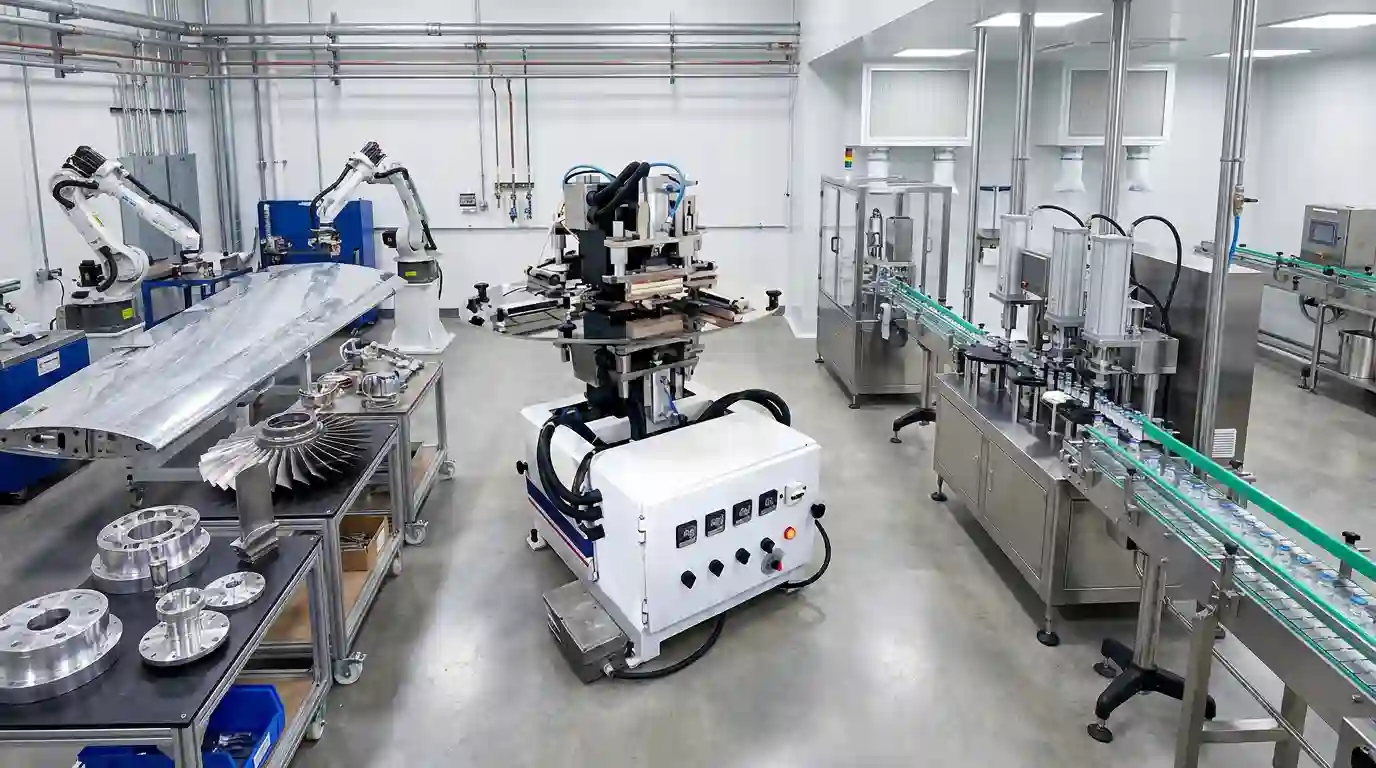
An SPM is a machine made for one operation, or a short fixed set of them. A normal lathe gets re-set for different jobs. An SPM doesn’t. Its fixtures, tooling and controls are all shaped around a single component, which is why SPM machines tend to run faster and wander less on that one task.
Here’s what sets them apart from everyday equipment:
- One operation, done well
- Fixtures made for the actual part
- Steady results over long runs
- Harder to change if the part design moves on
Why Aerospace and Pharma Industries Need Specialized SPMs
Neither industry has much room for “close enough.” One step done slightly off can hurt safety, compliance or quality, and people doing the same motion for eight hours will vary a little. Machines don’t tire. That’s the reason Aerospace Special Purpose Machines and pharmaceutical SPM solutions keep getting asked for.
So what do these plants actually want from a machine?
- Accurate positioning
- The same result, batch after batch
- Fixed, controlled steps
- Predictable cycle times
- Safer, guarded operation for staff
- Automation shaped around the task
Special Purpose Machines in Aerospace Manufacturing
Aerospace parts are expensive and the paperwork is heavy. One missed detail on these parts can mean scrap or a rejected batch. So the fixture grips the part in the same position each time, and the machine takes it along one set path at one set force. Operators just load, check and adjust, rather than doing one motion over and over.
Jobs that usually go to these machines:
- Assembly and positioning
- Moving parts between stations
- Testing and inspection
- Other repeat precision work
Two of these deserve a closer look.
Precision Assembly and Component Handling
Hold the part accurately, move it the same way each cycle, and most of the assembly problems never show up. With delicate or costly parts, purpose-built handling also means fewer drops and less touching. That’s where aerospace SPM machines fit into precision manufacturing machinery plans. Honestly, a well-made fixture does half the work.
Testing and Inspection Applications
Checking a part beside the line means fewer trips back and forth. Gauges, test fixtures and controlled loading show whether a part meets its requirement before it goes any further. A well-built set of industrial testing machines also keeps a record of what was checked. If a question comes up months later, that record answers it.
Pharmaceutical SPM Solutions and Their Applications
In a pharma plant, a step either repeats exactly or it causes trouble, so the equipment has to hold that line too. Typical uses for pharmaceutical SPM solutions include production support, part handling, inspection, assembly and packaging-related jobs. One machine might shift items between stations. Another might hold them for a check or finish a single assembly step. Since the unit is built around the product, the line doesn’t have to bend to suit it. Small details like cleaning access are easy to miss early and costly to fix later.
A good SPM Machine Supplier will usually ask about:
- How easy it is to clean and maintain
- Guarding for operators
- How it sits on your existing line
Automated Production and Handling Processes
Automation lifts repetitive handling off people and makes each cycle behave the same. Planned properly, industrial automation machinery cuts manual work, though someone still needs to keep an eye on it. In practice you’ll see:
- Less repetitive work for operators
- Even handling across batches
- Steadier cycle times
- Fewer handling differences
Pneumatic & Hydraulic SPMs for Industrial Operations
Inside most of these machines, motion comes from compressed air or from oil under pressure. Pneumatic & Hydraulic SPMs behave quite differently once they’re running. Air is quick but a bit springy under heavy load, while oil holds firm. Some machines use both, air for fast positioning and oil for the working stroke.
Put simply:
- Pneumatic: runs on air, so it’s fast and clean, though the force stays on the lighter side. Fine for clamping and positioning
- Hydraulic: runs on oil and stays steady under heavy loads, which is why it’s the usual pick for pressing and forming
Trivia: Pascal’s work in the 1600s showed that pressure on a confined liquid spreads evenly through it. That one idea is why a small hydraulic input can lift or press something very heavy.
Key Benefits of Special Purpose Machines
What do plants get back for the investment? Mostly output and consistency. With Special Purpose Machines, the machine is shaped around your component instead of the other way round, and that’s where most of the value comes from. Don’t expect everything on day one, though. Consistency usually builds as the machine settles into regular production.
The main gains are easy to list:
- More output on repeat work
- Reliable repeatability
- Shorter cycle times
- Customisation around the part
- Less manual intervention
- Better line efficiency overall
None of it is automatic. It depends on sound design and a clear understanding of the part, so plan early.
How to Choose a Special Purpose Machine Manufacturer
The design matters, but so does who builds it. A machine is only as good as the engineering behind it. When comparing a Special Purpose Machine Manufacturer, or looking for a special purpose machine manufacturer in India, ask for proof instead of promises: drawings, past work, how they inspect.
Things worth checking before you commit:
- Can they customize for your component?
- How deep is their design and fixture knowledge?
- What quality checks do they follow?
- Have they worked with automation?
- Will they support you after delivery?
- Do they understand your industry?
Integrated Solutions offers CAD design, jig and fixture design, CNC and VMC machining and tool room work in one place, backed by over 20 years of engineering experience.
|
Looking for a dependable special purpose machine manufacturer in India? Talk To Integrated Solutions to go over your part, the machine you need and the output you expect. |