
Table of Contents
- What Is CNC Machining?
- Why Is It Important? (Working Principle)
- Types of CNC Machines
- Features to Look For in a Manufacturing Partner
- The CNC Machining Process, Step by Step
- Benefits of CNC Machining
- Applications of CNC Machining
- Comparison of Common CNC Machining Methods
- Expert Tips / Buying Guide
- Integrated Solution
- Conclusion
Walk onto any factory floor today and one thing stands out. Machines cutting metal with zero hesitation, zero guesswork. That's CNC machining in action. It's the reason a bracket made in January looks exactly like the one made in December no drift, no "close enough." People typing CNC Machining near me into a search bar usually want one thing: parts that fit right the first time, without a dozen back-and-forth calls. So let's get into it what CNC machining actually means, how the machines behind it operate, and where you'll find this process doing the heavy lifting across industries. No fluff. Just the parts that matter if you're the one placing the order.
What Is CNC Machining?
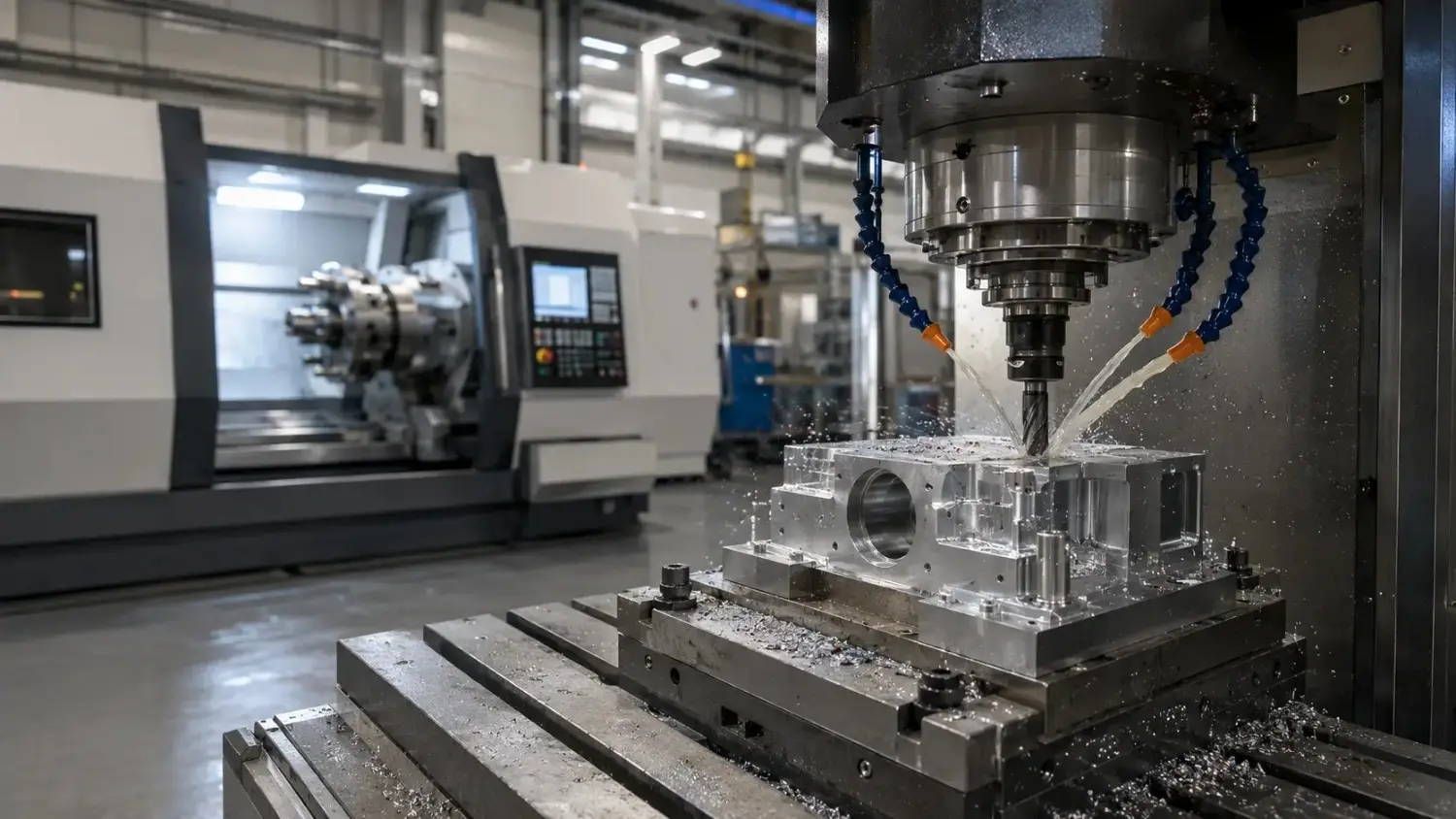
CNC stands for Computer Numerical Control. Strip away the jargon and it's simple software tells a machine exactly where to cut, how deep, and how fast, no manual guiding required. That's CNC machining in a nutshell. It's a subtractive process material gets removed from a solid block (the workpiece) until what's left is the finished shape. Manual milling depends on a steady hand. CNC doesn't. Feed it the same program twice and you'll get the same part twice. The CNC Machining Process usually kicks off with a CAD file, gets translated into machine code, and ends with a part sitting on the inspection table. Nothing mysterious about it just code, motors, and a cutting tool doing what it's told.
|
Trivia: Back in the 1940s, the earliest numerical control machines ran on punched paper tape no screens, no software, just holes in a strip of paper telling the machine what to do. |
Why Is It Important? (Working Principle)
Here's the CNC machine working principle in plain terms a controller reads coordinates, then drives motors along the X, Y, and sometimes Z axis (and beyond, on fancier setups) to move the tool or the workpiece with real precision. Feedback sensors watch every move. Drift a fraction of a millimeter and the system catches it before it turns into a rejected part. That's the whole point manual cutting relies on eyesight and experience; this doesn't.
- Same part, a thousand times over, without variation
- Barely any room for human error
- Turnaround beats manual machining most days
- Handles shapes a hand tool would struggle with
|
Did You Know: One CNC controller can hold hundreds of saved programs. Switch jobs and there's no recalibrating from scratch — just load the file and go. |
Types of CNC Machines
Not every part needs the same machine and using the wrong one usually means wasted stock or a part that just doesn't sit right. Two names come up constantly: the CNC milling machine and the CNC turning machine. Different jobs, different logic.
- CNC milling machine the tool spins, the workpiece stays put. Good for flat faces, slots, pockets.
- CNC turning machine works the other way around: the part rotates while a fixed tool shapes it. Shafts and bushings usually go through this.
- Need holes? CNC drilling machines handle depth and diameter with no drama.
- Hardened metal that won't budge under a regular cutter? That's where CNC EDM comes in — sparks do the cutting, not blades.
- Multi-axis setups cut down on repositioning. One clamp, multiple faces machined without moving the part around.
Features to Look For in a Manufacturing Partner
Picking a supplier isn't just about who owns the shiniest machine. Precision CNC Machining Services worth paying for come down to consistency — can they repeat the same quality on batch five hundred as they did on batch one? Can they turn around a design change without the whole schedule falling apart? Things worth checking:
- Machines covering milling, turning, and drilling — not just one trick
- An in-house tool room, so fixtures and inspection aren't outsourced
- Real experience across metals, plastics, alloys — not just one material
- Paperwork that backs up quality claims
- Comfortable doing a one-off prototype and a five-thousand-unit run
The CNC Machining Process, Step by Step
A solid CNC Machining Manufacturer In India won't skip steps just to save time. Here's roughly how it plays out:
- Design gets modeled in CAD first
- That design turns into CNC-readable code
- Material gets picked, workpiece gets clamped down
- Cutting happens milling, turning, drilling, EDM, whatever the part calls for
- Quality checks happen mid-process, not just at the end
- Final step: deburring, finishing, packing it up for dispatch
Benefits of CNC Machining
- Tight tolerances, every single time
- Less material wasted than manual cutting
- Faster runs once volumes go up
- Complex geometries without a pile of extra setups
- Programs, once validated, don't need constant babysitting
- Works across metals, plastics, composites pretty much anything solid enough to hold shape
Applications of CNC Machining
CNC machining applications show up almost everywhere manufacturing happens. Honestly, if a product has a metal or plastic part with a precise feature, there's a decent chance it passed through a CNC machine at some point.
- Automotive — engine parts, brackets, gearbox components
- Aerospace — structural fittings, precision housings
- Industrial gear — jigs, fixtures, tooling, machine parts
- Healthcare — surgical instruments, device housings
- Electronics — enclosures, connectors, small precision parts
Comparison of Common CNC Machining Methods
| Aspect | CNC Milling | CNC Turning | CNC Drilling |
|---|---|---|---|
| Workpiece Movement | Stationary | Rotates | Stationary |
| Tool Movement | Rotates and moves along axes | Stationary, moves linearly | Rotates vertically |
| Best Suited For | Flat, angular, slotted parts | Cylindrical, round parts | Precise hole-making |
| Typical Output | Brackets, plates, housings | Shafts, bushings, rings | Bolt holes, mounting points |
| Complexity Handling | High, multi-surface | Moderate, symmetrical shapes | Low to moderate |
Expert Tips / Buying Guide
A bit of prep before signing off on a supplier saves headaches later:
- Send complete drawings with tolerances marked don't leave it to guesswork
- Ask if there's an in-house tool room; it speeds up iterations
- Get certifications confirmed upfront, especially for regulated industries
- Order a sample before committing to a big batch
- Check whether they're set up for both prototypes and volume runs
Integrated Solution
Integrated Solutions is a renowned company in India that deals in engineering and manufacturing of CNC machining, EDM solutions, rapid prototyping, tools design and other precision manufacturing services with 20+ years of experience. Integrated Solutions was established in 2004 by Mr. Rahul Chandel (Founder & CEO). Currently, Integrated Solutions is recognized as a leading manufacturer and supplier of advanced engineering solutions for applications within aerospace, automotive and other medical manufacturers. This is achieved through the combination of innovative technology and engineering skills to provide superior and cost-effective solutions globally.
Conclusion
CNC machining isn't one machine or a single trick — it's a whole system built around computer-guided precision, and it touches more of the objects around you than you'd probably guess. Ordering one prototype or running a full production line? Either way, understanding how the process works — and what a manufacturing partner should offer — puts you in a better spot before you place that order. A little groundwork upfront beats a rejected batch later.
| Need precision CNC machining services from a reliable CNC machining manufacturer in India? Contact Us Now to discuss your drawings, production requirements, and next batch. |