
Table of Contents
- Why Choosing the Right Rubber Mold Manufacturer Matters
- Check Their Rubber Mold Design Capabilities
- Evaluate Their Tooling Design for Rubber Molding
- Review Manufacturing and Machining Capabilities
- Check the Types of Rubber Molds They Can Develop
- Assess Quality Control and Mold Testing Process
- Consider Custom Rubber Molding Support and Scalability
- Questions to Ask Before Selecting a Rubber Mold Manufacturer
- Conclusion
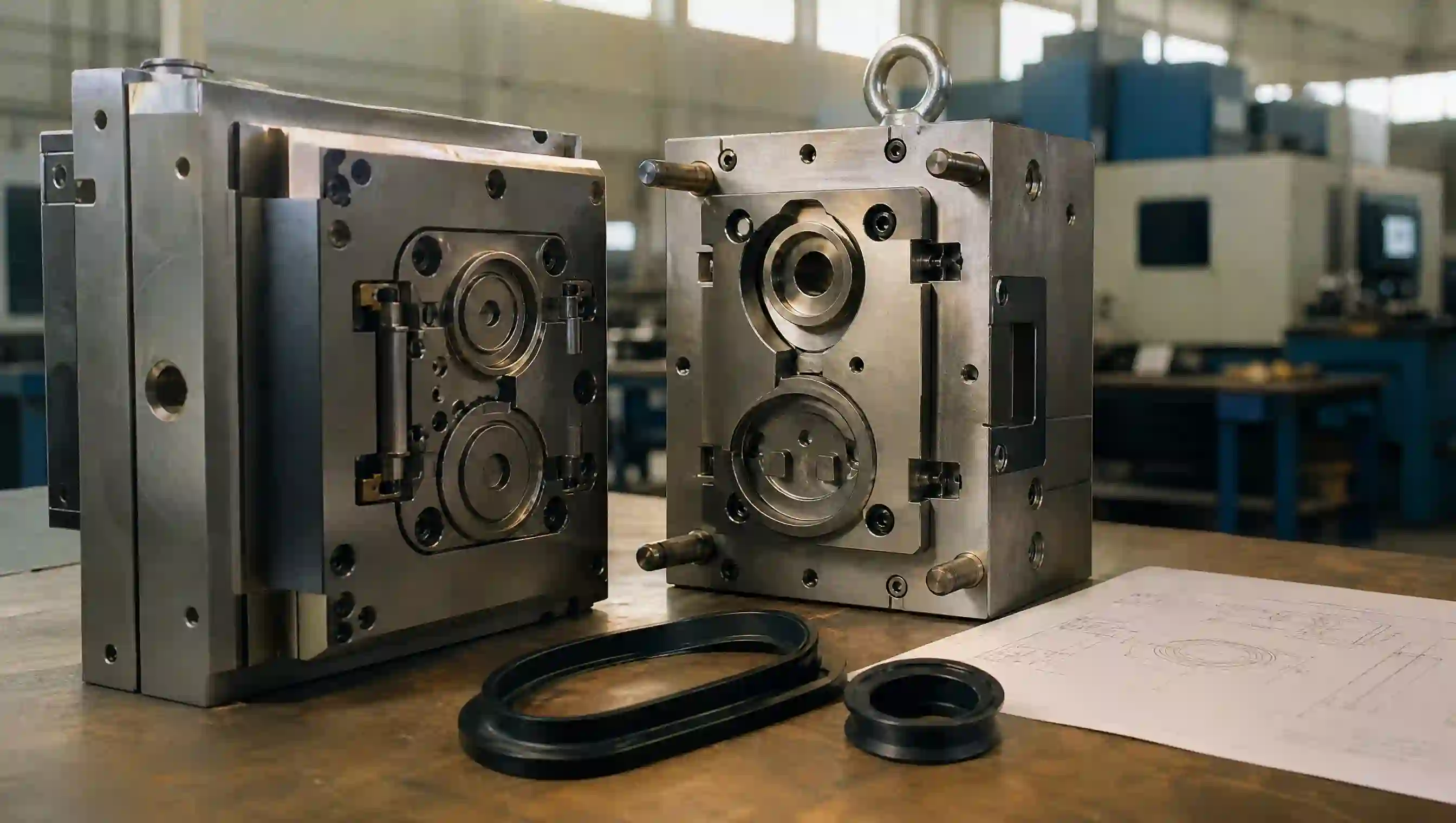
It is extremely important to select the correct custom rubber mold manufacturer to ensure the accuracy of the size, cycles, and quality of the rubber parts production. Appropriate rubber molds help in minimizing defects, quality consistency, and repeated manufacturing of parts. Prior to selecting the manufacturer, it is advisable to consider the design capabilities, tooling capabilities, machining capacity, inspection capacity, and capability to meet the particular project needs of the business organization. Suitable custom rubber mold manufacturers will be aware of the part geometry, rubber type, operational conditions, and production volume of the parts to be manufactured.
Why Choosing the Right Rubber Mold Manufacturer Matters
The quality of the mold determines the quality of the rubber part produced.Incorrect mold designs and improper machining can lead to dimensional variations, flashing, air traps, and many other problems. This will increase the rate of rejection, scrapping, and manufacturing costs.
Integrated Solutions, a professional Rubber Mold Manufacturer In India should be fully aware of the factors that influence the final product through the mold design, cavity design, materials used, and processing. Efficient tools can ensure cycle time consistency as well as ease production processes.
In the course of rubber molding solution evaluation, apart from focusing on the cost of the mold, it is important to consider its manufacturability, durability, maintenance requirements, and technical assistance provided by the manufacturer.
| Factor | What It Means for Your Choice |
|---|---|
| Wood Type | Finer teeth for hardwood, coarser for softwood |
| Cut Direction | Rip teeth along the grain, crosscut across it |
| Material Thickness | Thicker stock needs a longer blade and lower TPI |
| Precision Needed | Higher TPI for visible joints and clean edges |
| Frequency of Use | Daily use justifies better steel and a better grip |
| Working Environment | Damp sites need dry storage and regular wiping |
Check Their Rubber Mold Design Capabilities
A good design of a mold starts from the understanding of a component drawing and the purpose of that particular part. An industrial company providing Rubber Mold Design Services should have the ability to examine geometry, dimensions, tolerances, and material of the component drawing prior to making the design.
Both CAD/CAM systems can be used while designing the mold and machining process. The shrinkage allowance, cavity design, parting lines, venting, and extraction process of the molded product are some of the factors which need to be considered during the process of designing the mold.
The type of rubber being used for molding also needs to be considered while designing the custom rubber mold.What fits one material may not necessarily fit another one. This way, the possibility of unnecessary changes in the design and unnecessary expenses on tooling can be avoided.
Look for Application-Specific Mold Design Experience
Various industries need rubber parts with different dimensions, hardness, tolerance, and functional characteristics. The seal, gasket, vibration-dampening part, cover and other industrial parts may have various demands in their mold design.
The knowledge of the purpose, material specification, and manufacturing environment is needed to be known in a Custom Rubber Mold Manufacturer business. Such expertise is helpful in making industrial rubber molds according to the purpose and expected manufacturing volume.
Evaluate Their Tooling Design for Rubber Molding
Tooling design for rubber molding determines the way rubber molding will occur in the mold and the consistency with which the final product will be produced. It is recommended that the mold plates, inserts, cavity design, parting line, venting, and material flow design should be analyzed, if necessary.
A good rubber mold tooling design will provide the possibility for rubber material to flow through the required areas and help to get rid of any air entrapment and minimize any flashing. It is also important to pay attention to the number of cavities, which will correspond to the product size, press capacity, and output.
In case of a complex product, custom inserts will be necessary to manufacture certain features and to reduce future maintenance. The manufacturer will have to describe the tooling design, maintenance requirements, and any possibility for further changes.
Review Manufacturing and Machining Capabilities
The mold design will produce the required output only if it is produced with precision. Before you select a rubber mold manufacturer, take note of the machining procedure, production facility, and inspection tools used in making the mold. There are several procedures used in making molds, including CNC machining, EDM, drilling, grinding, and surface finishing.
Precision in rubber mold manufacturing is extremely important in cavity sizes, parting lines, and locating features. It will affect the dimensions of the molding products, alignment, and surface finish of the mold.
While considering custom rubber molding services India, verify whether machining operations are done in-house or subcontracted. Find out also how the dimensional accuracy is checked and how design changes are handled. Such an analysis will help you to evaluate the capabilities of the manufacturer to meet your tooling and production needs.
Check the Types of Rubber Molds They Can Develop
The appropriate choice of rubber mold type would be determined by component design, rubber material, equipment to be used, and anticipated production volume.
- Compression Rubber Molding: The rubber is put inside the open mold cavities, and is heated and compressed at the same time. This process is widely used in making various seals, gaskets, and rubber-shaped products.
- Transfer Molding: The rubber material is first placed inside a transfer chamber before being forced into the mold cavities. It can be considered suitable for complex shapes or multiple cavity molds.
- Injection Molding of Rubber: Rubber material is molded into closed mold cavities through the injection system. This would be possible if the rubber material, machine, and component design are suitable for the purpose.
- Prototype and Custom Molds: Prototype tooling will prove useful in establishing the design before taking up production tooling. Custom mold design will depend upon the requirements of individual components.
The custom rubber mold will depend on design, rubber material, and manufacturing process and not only on cost.
Assess Quality Control and Mold Testing Process
Quality checks are useful to make sure that the mold meets the approved design and produces parts as per the needed specifications. Manufacturers have to make sure they conduct cavity measurement, surface measurement, and mold alignment, among others, to ensure rubber mold quality.
Rubber mold testing could involve making trial runs using the right rubber material under the right processing conditions. These tests will be carried out to make sure there is conformity in terms of dimensions, appearance, flash and others.
Quality assurance becomes very important in making precision rubber molds since there is a need for accuracy and consistency in such molds. In case the sample fails to meet the drawing specifications, manufacturers should figure out why and determine whether to modify the mold or process. Make sure you know the criteria of accepting the sample before approving the mold.
Consider Custom Rubber Molding Support and Scalability
Tooling requirements will vary as the product evolves from the development stage into the production stage. In the selection of Custom Rubber Molding Services India, one should find assistance for prototype development, design changes, replacements of insert, mold upkeep, and repeat tooling as your requirements evolve.
The dependable custom rubber mold manufacturer should be capable of discussing your present production requirements and anticipated future demands. Low volume jobs may need a completely different cavity layout and tooling cost compared with high volume production parts.
In assessing rubber molding services,It may require a whole new cavity setup and tooling expense in comparison to high volume production parts.
When it comes to the evaluation of rubber molding services, it is necessary to consider lead time, availability of spare parts, tooling adjustments, and technical support. It will enable you to understand your needs related to the production process and its future changes.
Questions to Ask Before Selecting a Rubber Mold Manufacturer
It is important to ensure that the supplier is able to inform him on the kind of rubber that he can make using this mold and what the tolerance is for the same. Lead time, tooling life, sampling, and inspection should also be discussed. All these information pieces will give you an idea if the mold fits your product requirements.
Some additional things to look for include the ability to customize designs, mold maintenance service, and replacement parts. In case of a large project, ask about the production capacity and follow up on reordering for meeting the increasing demands.
When choosing rubber mold manufacturers, Integrated Solutions is the best, taking into consideration not only their technical competence but also their ability to communicate and provide post-sale services, as well as the price offered by them. Choosing a good rubber mold manufacturer in India will help in selecting proper molds.
Conclusion
In order to choose a custom rubber mold manufacturer, an assessment of design skills, tooling skills, machining skills, testing and technical support is necessary. The proper Rubber Mold should be one which matches your drawing, material, and production volume. It is recommended that you compare the technical capabilities of the manufacturer rather than the cost of the service prior to choosing the one for your mold needs. Integrated Solutions can advise you on the right mold design for your project.