
Table of Contents
- What Are Thermoset Components?
- Why Is Material Choice So Important?
- Types of Thermoset Materials
- Features to Look For
- Product Overview: How Thermoset Parts Get Made
- Benefits of Choosing Thermoset Components
- Where These Parts Actually Show Up
- Injection Moulding vs. Compression Moulding — A Quick Comparison
- Expert Tips for Buyers
- About Integrated Solutions
- Conclusion
A part softens under heat. The whole line stops. Sound familiar? This is exactly the gap thermoset materials were built to close — they don't melt, they don't sag, they just take the heat. Picking the right thermoset components isn't something to rush through on an order form. Get it wrong and you're paying for it in downtime, not just part cost. So here's the breakdown: what these components actually are, what variants exist, and how a solid thermoset component manufacturer turns raw resin into something that survives real stress. Nothing padded here. Just what you'd want to know before signing off.
What Are Thermoset Components?
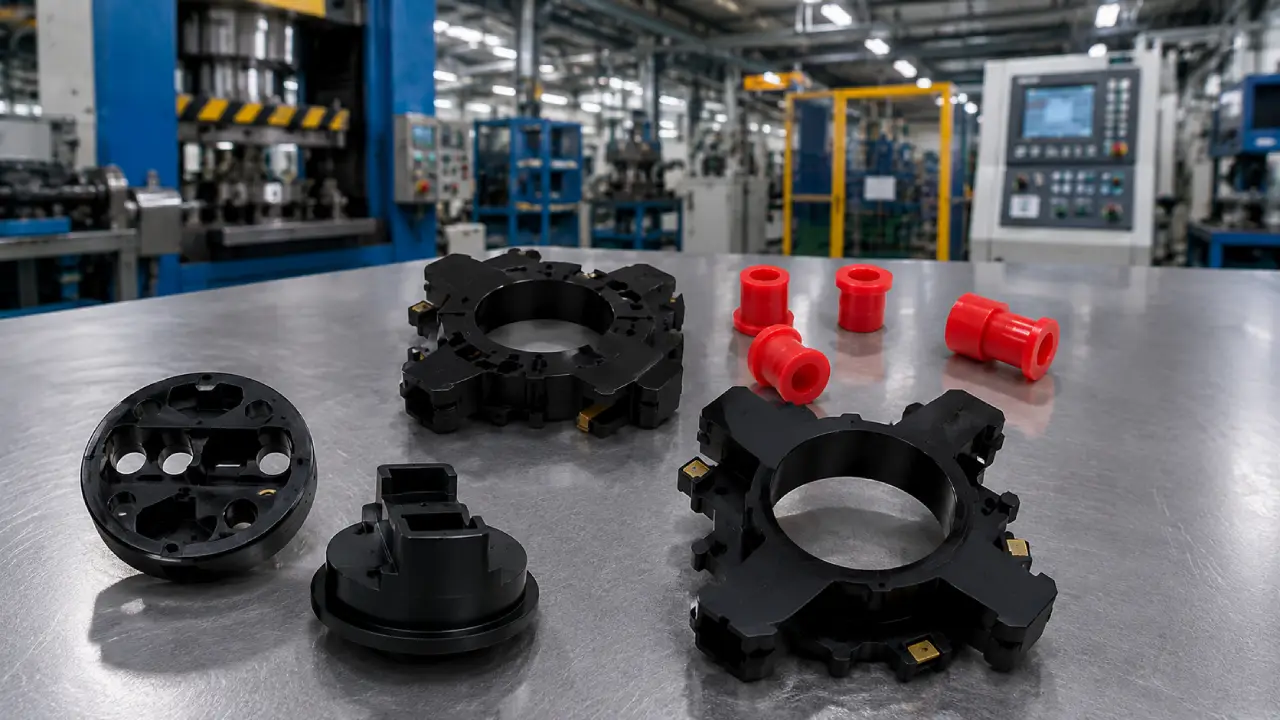
Simple version first. Thermoset components are moulded from polymers that cure once — heat or a catalyst sets them, and that's it. No going back. Thermoplastics melt back down if you heat them again. Thermoset materials don't — the molecules cross-link once and stay locked, and that's the whole point of using them. After curing, these parts barely react to deformation, chemicals, or electric current — something soft plastics struggle with. Take insulators, switchgear housings, or a bracket near a hot engine. Bending isn't an option for any of them. A good thermoset component manufacturer usually keeps epoxy, polyester, and phenolic resins on hand, choosing based on what the job calls for.
Why Is Material Choice So Important?
Here's the blunt answer: failure costs more than the part. A bracket that warps, an insulator that shorts out — either one can shut down a whole system, sometimes mid-shift. Thermoset parts fix that at the material level. They hold their dimensions, resist chemical attack, and generally outlive the machine they're bolted into. In electrical and automotive work, that isn't a bonus feature. It's table stakes. Which is why picking from established Thermoset Component Suppliers matters — resin choice and moulding quality together decide if a part runs five years or dies in five months.
Types of Thermoset Materials
Not every thermoset resin does the same job. A quick rundown:
- Epoxy-based components – strong bonding, great electrical insulation. Shows up a lot in circuit protection and power gear.
- Polyester resin parts – cheaper, reasonably corrosion-resistant. Fine for general industrial work where budgets matter.
- Phenolic components – hard, heat-tolerant, chemically stable. Common in electrical parts and some decorative-industrial pieces too.
- SMC (Sheet Moulding Compound) – fibre-reinforced. Goes into bigger, structurally heavier parts.
- DMC (Dough Moulding Compound) – dense, strong, and a regular choice for switchgear housings or automotive enclosures.
- BMC and EMC – built for flame resistance and staying dimensionally stable, mostly in sensitive electronics.
Each type of thermoset moulded components has its own lane. Pick the wrong resin, and there's a decent chance you're redesigning the part inside six months.
Features to Look For
Before you sign off on a Thermoset Components Services provider, run through these:
- Can they actually do both — thermoset injection moulding and thermoset compression moulding — or just one?
- Multiple resins on offer (epoxy, polyester, phenolic), or stuck on one?
- Real tolerance data on finished thermoset parts. Not a sales estimate.
- In-house tooling, or is it outsourced somewhere and adding weeks to your timeline?
- Quality checks at every stage, not only a final glance before shipping.
- Can they handle a jump from prototype to full volume without the quality slipping?
Can't answer these clearly? That tells you enough already.
|
DID YOU KNOW? Bakelite got its patent in 1907 — most consider it the first fully synthetic plastic in existence. Thermoset moulding as we know it still traces back to that discovery. |
Product Overview: How Thermoset Parts Get Made
Two processes dominate thermoset moulding, and most decent facilities run both. Injection moulding forces heated resin into a cavity under pressure — good for intricate shapes, good for volume, consistent output run after run. Compression moulding takes another route — resin gets pressed between heated mould halves, and that tends to work out better for thicker, heavier parts. A serious thermoset components exporter keeps both routes open instead of forcing every job through one process. Which one fits your part comes down to geometry, wall thickness, and expected load. Not whatever's easiest for the moulder that day.
|
TRIVIA Thermoset plastics typically keep their strength up around 200°C or beyond. Most thermoplastics start giving up well before that. |
Benefits of Choosing Thermoset Components
So why do engineers keep coming back to thermoset materials instead of switching? A handful of reasons keep it that way:
- Handles heat without losing shape.
- Dimensionally stable — tolerances stay put even as the part ages.
- Stands up to chemicals and corrosion in rough environments.
- Excellent electrical insulation, which matters a lot for switchgear and circuits.
- Works out cost-effective once you're producing at scale, especially with DMC or SMC.
- Long service life. Fewer replacements. Cuts down on the downtime nobody planned for.
- Room to design flexibly too — fibre-reinforced, flame-resistant, whatever the job calls for.
You won't need every benefit on every job. But two or three lining up usually makes thermoset the obvious pick.
Where These Parts Actually Show Up
In the field, here's where you'll run into them most:
- Electrical and electronics — insulators, LED housings, semiconductor packaging, circuit protection.
- Automotive — switchgear parts, under-the-hood brackets, structural housings.
- Industrial machinery — enclosures, panels, protective housings.
- Power systems — connectors, terminal blocks, high-voltage insulation.
Basically, if a component has to deal with heat, vibration, and chemical exposure all at the same time, odds are good it started life as a thermoset compound.
Injection Moulding vs. Compression Moulding — A Quick Comparison
A general side-by-side of the two main thermoset moulding routes. No pricing, no fixed dimensions — just the process basics worth knowing before you pick one.
| Aspect | Injection Moulding | Compression Moulding |
|---|---|---|
| Best Suited For | Complex shapes, high-volume runs | Thick, structurally heavy parts |
| Cycle Speed | Faster, generally | Slower by comparison |
| Tooling Investment | Higher upfront cost | Usually lower |
| Material Flow | Injected under pressure | Pressed between heated mould halves |
| Typical Use | Electronics, smaller components | Automotive, heavier enclosures |
Expert Tips for Buyers
A short list worth keeping in mind before an order goes out:
- The cheapest quote isn't automatically the smart one. Check where quality control actually happens in the process.
- Always ask for sample parts first. No exceptions.
- Vendors who run both moulding methods save you the headache of switching mid-project.
- Export experience is a decent proxy for tighter documentation and steadier standards.
- Let engineers pick the material, not the sales team.
- Heavy heat or load swings? Get thermal performance numbers before delivery, not after.
Sorting through Thermoset Components Manufacturers In India isn't about the lowest number on a quote sheet. It's about who won't budge on your tolerances.
|
FACT Once thermoset resin cures, that's final — it can't be remelted or reshaped. That permanent cross-linking is exactly what gives it heat and chemical resistance. |
About Integrated Solutions
Integrated Solutions is a renowned company in India that deals in engineering and manufacturing of CNC machining, EDM solutions, rapid prototyping, tools design and other precision manufacturing services with 20+ years of experience. Integrated Solutions was established in 2004 by Mr. Rahul Chandel (Founder & CEO). Currently, Integrated Solutions is recognized as a leading manufacturer and supplier of advanced engineering solutions for applications within aerospace, automotive and other medical manufacturers. This is achieved through the combination of innovative technology and engineering skills to provide superior and cost-effective solutions globally.
Conclusion
Three things decide whether your thermoset components hold up: the resin, the process, and the manufacturer behind the job. Miss one of those and you're looking at early failure or a redesign nobody planned for. Get all three right, and the part quietly does its job for years without anyone thinking about it again. Whether that means thermoset injection moulding for a tight electronic housing or thermoset compression moulding for a heavy-duty enclosure, the process has to fit the part. Not the other way round.
Need dependable thermoset components for your next build? Talk to an experienced thermoset component manufacturer such as Integrated Solutions and get your specs reviewed today. Contact Us Now! |