
Table of Contents
- What is Rapid Prototyping?
- Types of Rapid Prototyping Technologies
- Advantages of Rapid Prototyping
- About Integrated Solutions
- Uses of Rapid Prototyping
- How to Select the Right Prototyping Partner?
- Key difference Between Rapid Prototyping and 3D Printing
- What is 3D Printing?
- Types of 3D Printing Technologies
- Advantages of 3D Printing
- Uses of 3D Printing
- Technical Specification
- Relationship Between Rapid Prototyping and 3D Printing
- Rapid Prototyping vs 3D Printing: Which is Better?
- Why Choose Integrated solutions for rapid prototyping and 3D printing?
In view of the current fast-changing dynamics in the manufacturing industry, there is a need to design new products quickly, design efficient processes for producing those products, and manufacture them in the best manner possible. There is a clear relationship between Rapid Prototyping and 3D Printing that cannot be stressed enough.
There are many industries around the world that are taking advantage of Rapid Prototyping Services to reduce the amount of time it takes to develop new products and improve product quality. Conversely, there are many companies within India that are now utilizing 3D Printing Services.
What is Rapid Prototyping?
Rapid Prototyping is a method of manufacturing where a prototype is made for any item or product using the most advanced technique available within a short timeframe.
The need for rapid prototyping services has increased significantly among modernized industries. By using rapid prototyping, manufacturers can validate their products, test concepts and manufacture small runs of their product. Using a reliable company that offers rapid prototype services will allow customers to reduce the overall amount of time it takes to develop a new product while still keeping the accuracy of the design.
Fun Fact: “NASA used Rapid Prototyping techniques as far back as the Space Shuttle era to create complex components, but didn't rely on commercial 3D printers until the 2010s.”
Types of Rapid Prototyping Technologies
The following are some of the types of rapid prototyping technologies:
1. CNC Machining
CNC rapid prototyping is widely used for creating highly accurate and durable prototype parts. CNC machines remove material from a solid block to achieve the required design.
The benefits of using CNC for rapid prototyping include:
- Great surface quality
- High dimensional accuracy
- Stronger components made from metal or plastic
- Able to create prototype parts that are engineered to the same standards as the final product
2. Vacuum Casting
The CNC rapid prototyping method is an effective way to produce low-volume prototypes by using silicone molds.
3. Injection Molding Prototype
Injection molding involves creating prototype parts out of the same materials and dimensions as the actual finished products.
4. Additive Manufacturing
Refers to 3D printing processes used to create prototypes quickly and flexibly.
Always choose reliable and trustworthy sources of 3D Printing Rapid Prototyping Services like Integrated Solutions.
Did you know? ‘Early RP techniques included Stereolithography (SLA), Selective Laser Sintering (SLS), and Fused Deposition Modeling (FDM) — all very different processes under one umbrella.”
Advantages of Rapid Prototyping
Here are some of the advantages of rapid prototyping:
1. Faster Product Development
Rapid prototyping helps manufacturers quickly test and refine products prior to full-scale production.
2. Reduced Manufacturing Errors
Design problems can be spotted at an early stage.
3. Improved Product Quality
Testing alternative versions will assess both function and performance.
4. Better Communication
Using tangible prototypes can enable teams and clients to understand product designs better.
5. Cost Savings
Reduces the risk of incurring high costs due to production errors.
Many businesses are looking to professional rapid prototyping services for fast innovation as well as being able to deliver successful products.
About Integrated Solutions
‘Integrated Solutions is a renowned company in India that deals in engineering and manufacturing of CNC machining, EDM solutions, rapid prototyping, tools design and other precision manufacturing services. Integrated Solutions was established in 2004 by Mr. Rahul Chandel (Founder & CEO). Currently, Integrated Solutions is recognized as a leading manufacturer and supplier of advanced engineering solutions for applications within aerospace, automotive and other medical manufacturers. This is achieved through the combination of innovative technology and engineering skills to provide superior and cost-effective solutions globally.’
Uses of Rapid Prototyping
The following are some of the uses of rapid prototyping:
1. Automotive Industry
Commonly used for engine parts, interior dash components, and assembly testing.
2. Aerospace Industry
Aids in the development of prototypes that are lightweight and precisely manufactured.
3. Medical Industry
Used to support all types of surgical models, implants and test equipment.
4. Electronics Industry
Used to evaluate housings and internal assembly quality on devices.
5. Industrial Equipment
Utilized to test components of industrial machinery prior to being manufactured at large scales.
Many organisations utilise the services of a reputable rapid prototype manufacturer to reduce cycle times for product development.
Experienced rapid prototype companies like Integrated Solutions are known for their best quality work.
Here is another blog you might be interested in.
Zero-Defect Plastic Molds: How High-Tolerance Tooling Cuts Your Production Lead Times by 30%
How to Select the Right Prototyping Partner?
Choosing the right service provider is essential for product quality and timely delivery.
1. Experience and Expertise
Partner with businesses with long industry experience.
2. Technology Availability
Confirm that they can supply CNC machining, 3D printing, and finishing processes.
3. Material Options
A good supplier should offer an array of sample part types, including plastic, resin, and metal.
4. Quality Standards
Consider the suppliers’ processes as well as their capabilities for quality control and inspection.
5. Delivery Speed
Partner only with established suppliers who ensure that the products get delivered right on time.
Integrated Solutions takes care of all the above mentioned factors.
Key difference Between Rapid Prototyping and 3D Printing
The following table talks about the rapid prototyping and 3d printing.
| Aspect | Rapid Prototyping | 3D Printing |
|---|---|---|
| Definition | Complete product development process | Manufacturing technology |
| Manufacturing Methods | CNC, casting, molding, additive manufacturing | Additive manufacturing only |
| Purpose | Testing and validation | Creating parts layer by layer |
| Material Options | Plastic, metal, rubber, composites | Mainly printable materials |
| Production Speed | Depends on process | Fast for small components |
| Accuracy | High with CNC methods | High for complex designs |
| Cost | Varies according to process | Economical for prototypes |
| Applications | Product development and testing | Customized and complex part creation |
What is 3D Printing?
3D printing is a technology used to build a part layer by layer using a 3D model stored in a digital file format. 3D printed parts can be produced from many different materials such as plastics, resins, and metals depending on their intended use.
Currently, companies utilize advanced printers to create customized components, prototypes, and functional items. A lot of companies searching for the best way to use a 3D printer are concerned with print quality, material compatibility, speed, and dependability.
3D Printing Services have grown in popularity in India due to the fact that 3D printing does not require costly tooling to manufacture complicated geometries.
Fun Fact: “FDM (Fused Deposition Modeling), the technology behind most home 3D printers today, was invented by Scott Crump in 1988... using a hot glue gun as inspiration. He co-founded Stratasys afterward.”
Types of 3D Printing Technologies
The following are some of the types:
1. FDM (Fused Deposition Modeling)
The most common and least expensive option for designing a prototype.
2. SLA (Stereolithography)
It is ideal to choose this technique since it gives excellent results and creates a very smooth surface.
3. SLS (Selective Laser Sintering)
This technology produces strong, durable industrial parts using plastic, which are very suitable for industrial use.
4. Metal 3D Printing
It offers rapid prototyping of metals for use in the aerospace, automotive, and medical sectors.
Advantages of 3D Printing
Here are some of the advantages of 3D printing:
1. Complex Design Capability
3D printing can be used to create complex geometrical forms and designs which cannot be achieved through other conventional techniques.
2. Reduced Material Waste
3D printing uses only the material needed for the print being produced, which reduces the amount of waste generated during the production of a model or sample.
3. Faster Prototype Creation
Industries can quickly produce prototypes and samples as needed.
4. Customization
3D printing is ideal for producing customized items for specific customers and low-volume productions for less than other production methods.
5. Tool-Free Manufacturing
Less production costs: Since there is no need for tooling or molds during the production of a prototype, costs are reduced significantly.
This explains why 3D Printing Services In India are increasingly gaining popularity in several industries.
Uses of 3D Printing
Key uses of 3D printing:
1. Product Design
3D printing allows designers to create prototypes visually and functionally.
2. Customized Manufacturing
Manufacturing products to match customer preferences is one of the ways manufacturers are able to use customization as an advantage.
3. Healthcare Applications
3D printing can also be utilized to create dental services, prosthetics, and surgical processes.
4. Architecture Models
Architects can utilize 3D printing to create models of their buildings in great detail.
5. Educational Projects
3D printing is being used almost solely in the educational arena to provide an alternative means of teaching in the engineering and technical industries.
3D printing companies often search for suppliers of rapid prototyping and machine-based prototypes by searching with the terms "3D printing near me."
Technical Specification
The following table talks about rapid prototyping and 3D printing.
| Specification Component | 3D Printing | Rapid Prototyping |
|---|---|---|
| Core Technology | Additive Manufacturing | Prototype Development Process |
| Manufacturing Method | Layer-by-Layer Fabrication | Additive and Subtractive Manufacturing |
| Technologies Used | FDM, SLA, SLS, DMLS | CNC Machining, Vacuum Casting, Injection Molding, 3D Printing |
| Materials Used | PLA, ABS, Resin, Nylon, Metal | Plastic, Metal, Resin, Composite |
| Design Capability | Complex Geometries and Intricate Structures | Functional and Engineering Prototype Development |
| Surface Finish | Smooth, Matte, Textured, Polished | Machined, Coated, Industrial Finish |
| Accuracy Level | High Precision for Complex Parts | High Dimensional Accuracy |
| File Compatibility | STL, OBJ, STEP | STEP, IGES, STL |
| Prototype Purpose | Visual Models and Custom Parts | Functional Testing and Design Validation |
| Production Type | Low-Volume and Customized Manufacturing | Product Testing and Pre-Production Validation |
| Structural Features | Hollow Structures and Lightweight Designs | Durable and Functional Engineering Components |
| Lead Time | Fast Prototype Printing | Fast Product Development Cycle |
| Industrial Applications | Healthcare, Automotive, Architecture, Consumer Products | Aerospace, Automotive, Industrial Equipment, Electronics |
| Finishing Options | Sanding, Painting, Polishing | Machining, Coating, Surface Treatment |
| Material Waste | Reduced Material Usage | Depends on Manufacturing Process |
| Engineering Support | Digital Design and Prototype Assistance | Product Development and Functional Analysis |
| Production Advantage | Tool-Free Manufacturing | Faster Product Development and Error Reduction |
| Services Provided | Custom 3D Printing and Prototype Manufacturing | Prototype Development, Functional Testing, Product Validation |
Relationship Between Rapid Prototyping and 3D Printing
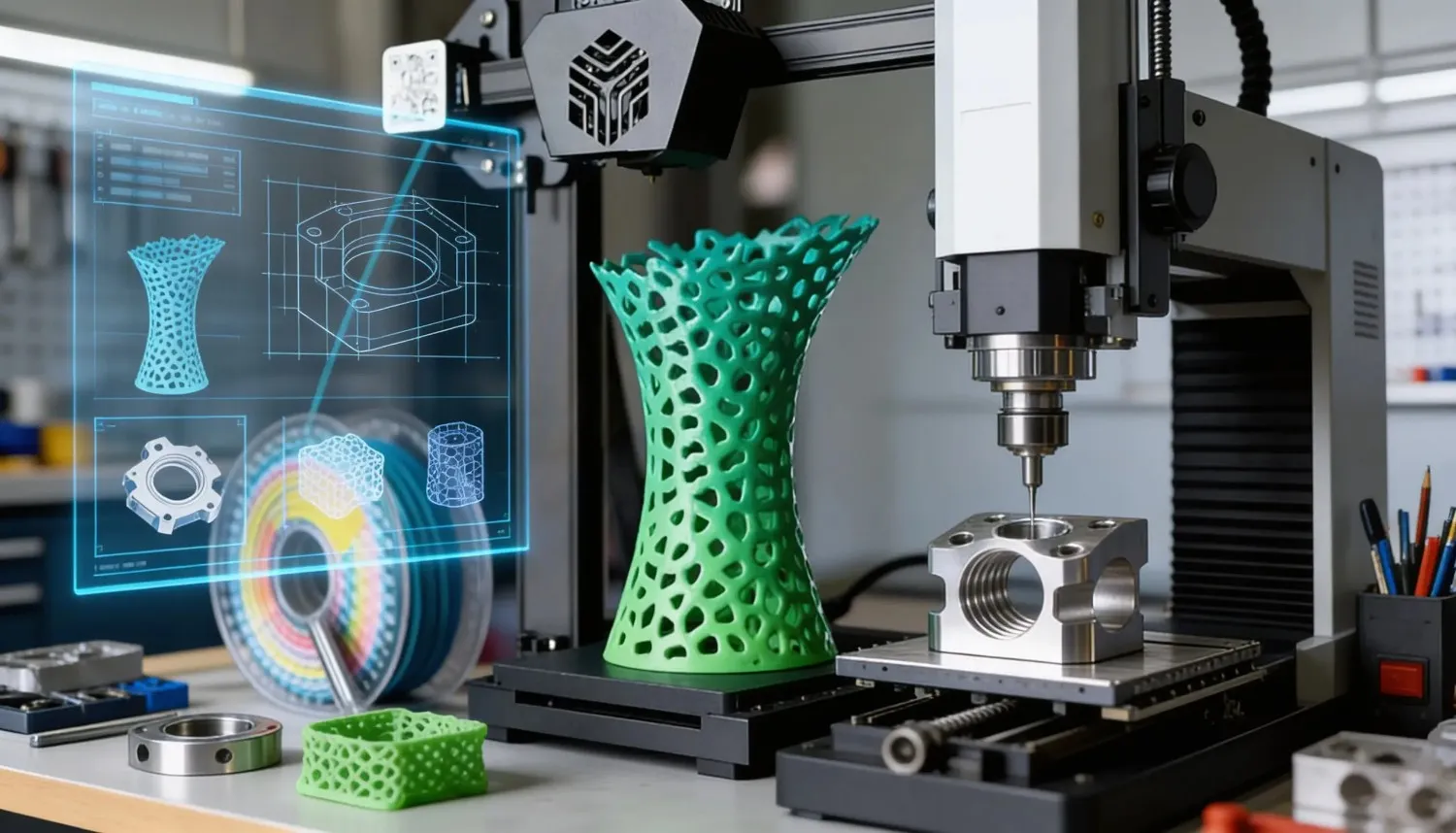
3D printing is one of many types of technologies used for rapid prototyping, however the term rapid prototyping is generally used to describe multiple technology types that produce prototypes.
For example:
- A prototype is created through 3D printing by using the additive manufacturing process.
- A prototype can also be produced through either a subtractive manufacturing method such as CNC machining, or by using silicone molds such as vacuum casting.
Therefore all 3D printed prototypes can be considered to have been rapidly prototyped, although there are many other types of rapidly prototyped products that were not manufactured using 3D printing.
Many industries will create valiant attempts to combine rapid prototyping services manufactured through 3D printing with those manufactured through other machining techniques to produce higher quality final products sooner than if there were to produce the products separately.
Rapid Prototyping vs 3D Printing: Which is Better?
Your decision should depend on the specific project requirements.
Choose Rapid Prototyping When:
- You need to create precise parts.
- You need to create functional prototypes.
- You need to make use of multiple manufacturing techniques.
- You need to machine metal parts.
Choose 3D Printing When:
- You are producing complex geometric shapes.
- You need to create visual prototypes quickly.
- You are producing a small amount of product.
- You do not want to incur the expense of creating a prototype.
Many companies use a combination of 3-D printing and machining (CNC) to improve process efficiency.
Why Choose Integrated solutions for rapid prototyping and 3D printing?
Here are some of the reasons:
- They provide a variety of 3-D model types that allow you to duplicate specific geometries with high accuracy.
- They provide a high level of detail within the design using advanced CAD tools.
- They provide rapid prototyping machining with CNC equipment that produces models that meet the same specifications as the final product.
- They employ many experienced engineers who have provided prototypes to companies in the aerospace, automotive, defence, and industrial sectors.
Here are the most asked questions related to rapid prototyping and 3D printing.
Conclusion
In general, rapid prototyping and 3D printing are both integral parts of today's manufacturing industries. Rapid Prototyping is focused on developing and testing an entire product, while 3D Printing focuses on generating components with additive manufacturing techniques.
A rapidly increasing number of companies are beginning to utilize Rapid Prototyping Services and advanced 3D printing services in India for speedier development of innovations, decreased manufacturing costs, and greater accuracy in prototyping. All types of technology (CNC Rapid Prototyping and rapid metal prototyping) can assist a company to gain higher levels of productivity and produce better quality products in a shorter amount of time.
If you are thinking of investing in rapid prototyping and 3D printing, then Integrated Solutions is the right platform. The brand also deals in 2D drafting services, rubber molding, plastic parts, casting parts and much more.