
Table of Contents
- What Are Aluminum and Zinc Pressure Die Casting Tools?
- Role of Pressure Die Casting Tools in Automotive Manufacturing
- Key Design Features of High-Pressure Die Casting Tools
- Manufacturing Processes Used for Precision Die Casting Tools
- Quality Checks for Automotive Pressure Die Casting Tools
- Factors Affecting Custom Die Casting Tool Requirements
- Why Choose Integrated Solutions for Automotive Die Casting Tools?
- Conclusion
The automobile market requires metal parts, which provide dimensional precision, toughness, stability and reliable functioning. Most automotive parts such as transmission housings and motor covers, brackets and electrical covers require special tooling to achieve the required shape and quality. The production of these components is highly dependent on the use of aluminum zinc pressure die casting tools particularly in the need for repeatability and complex geometries.
When automotive companies need reliable tooling solutions, selecting well-established pressure die casting tool manufacturers can be a decisive move in enhancing the quality of production and long-term manufacturing success.
What Are Aluminum and Zinc Pressure Die Casting Tools?
High Pressure Die Casting dies are precision dies pressed into die metal parts by forcing in molten metal at high pressure. They will survive many thermal cycles and manufacturing pressures and still be dimensionally accurate.
Aluminum pressure die casting tools are used to create complex shapes of lightweight aluminum parts. Zinc pressure die casting tools are used for creating small, intricate parts that require accuracy and uniformity.
An average die casting tool is made up of:
- Die cavities: Delimit the form and size of the component.
- Core systems: Form holes, recesses and internal features.
- Die inserts: Bearable or wearable areas.
- Gating systems: Regulate the flow of molten metal into the cavity.
- Release systems: Free up air and gases.
- Cooling channels: Control die temperature.
- Ejection systems: The finished casting should be safely released.
These components are to be adequately coordinated to make sure that the tooling is in accordance with the functional and manufacturing requirements of the component.
Role of Pressure Die Casting Tools in Automotive Manufacturing
Automotive manufacturing entails a large variety of parts that need accuracy and consistency as well as effective production procedures. Die casting tools Automotive Die Casting Tools assist manufacturers to make metal components with complicated geometries and to ensure quality in parts throughput of manufacturing batches.
Die casting tooling can enable the manufacture of lightweight, compact and functional automotive components depending on the alloy chosen, component design and the way it is cast.
Automotive Housings and Structural Applications
Die casting of aluminum is usually regarded as an option in automotive applications, where reduction in weight, structural design, thermal control and size are considered.
Potential applications include:
- Housing of engines and transmissions
- Gearbox casing and gearbox covers
- Electric vehicle electric motor housings
- Car brackets and mounting pieces
- Housing of pumps and compressors
- Enclosures of sensors and equipment
A properly designed aluminum die casting tool assists in fitting the part geometry, wall thickness, the flow of the metal, cooling and machining allowances.
Electrical and Precision Automotive Components
Zinc die castings can commonly be used on smaller and detailed parts that need complex shapes and dimensional accuracy.
Potential automotive uses are:
- Electrical connector housings
- Sensor covers
- Small mounting brackets
- Hardware to lock and fasten
- Precision enclosure components
- Interior mechanism parts
When the alloy and the design are appropriately used in the application, a well-engineered Zinc pressure die casting tool can be used to create detailed features and repeatable components.
Key Design Features of High-Pressure Die Casting Tools
The design of tools directly affects the quality of casting, the efficiency of production, the life of tools and the uniformity of the final products. High-pressure die casting dies should be designed based on the geometry, alloy properties, operating conditions and anticipated quantity of production.
| Tooling Feature | Purpose | Manufacturing Benefit |
|---|---|---|
| Die Cavity Design | Determines the shape of the component. | Supports dimensional accuracy |
| Gating System | Seals liquid metal. | Helps obtain controlled filling of the cavities. |
| Venting System | Ejects air and gases. | Helps reduce porosity and filling defects |
| Cooling Channels | Regulate die temperature | Enables stability in heat and cycles. |
| Core and Inserts | Develop intricate internal and external characteristics. | Improves design flexibility |
| Ejection Mechanism | Lets go off the casting on the die. | Aids in consistent production. |
Gating, Venting and Cooling Systems
The gating system should be designed in such a way that it directs the molten metal into the die cavity at the right speed and direction. Lack of smooth flow of metal may lead to turbulence, entrapment of air and non-filling, among other defects in casting.
The venting and overflow systems allow avenues through which air, gases and undesired materials can be eliminated in the process of filling. Cooling channels are used to ensure appropriate thermal balance between the production cycles.
Good Design of Pressure Die Casting Tool takes these systems into consideration as a unit and not as a standalone feature. They are laid out depending on the geometry of the part, alloy, casting machine and conditions of the process.
Die Cavities, Inserts and Ejection Mechanisms
Die cavities are created to meet the necessary geometry of the component, shrinkage allowance, draft, parting line and dimensional tolerances.
Where wear is concentrated, or where machining of a tool is complicated, or where it is convenient to replace a tool part more easily on maintenance, tool inserts can be employed. Multi-cavity die casting tools could be taken into consideration in the case of multi-part production, in cases where component dimensions, machine capacity, filling balance and production requirements favor a multi-cavity.
Releasing mechanisms should not deform, damage the surface or unnecessarily stress the components. Ejector pins and associated mechanisms should be placed properly to ensure a reliable operation.
Manufacturing Processes Used for Precision Die Casting Tools
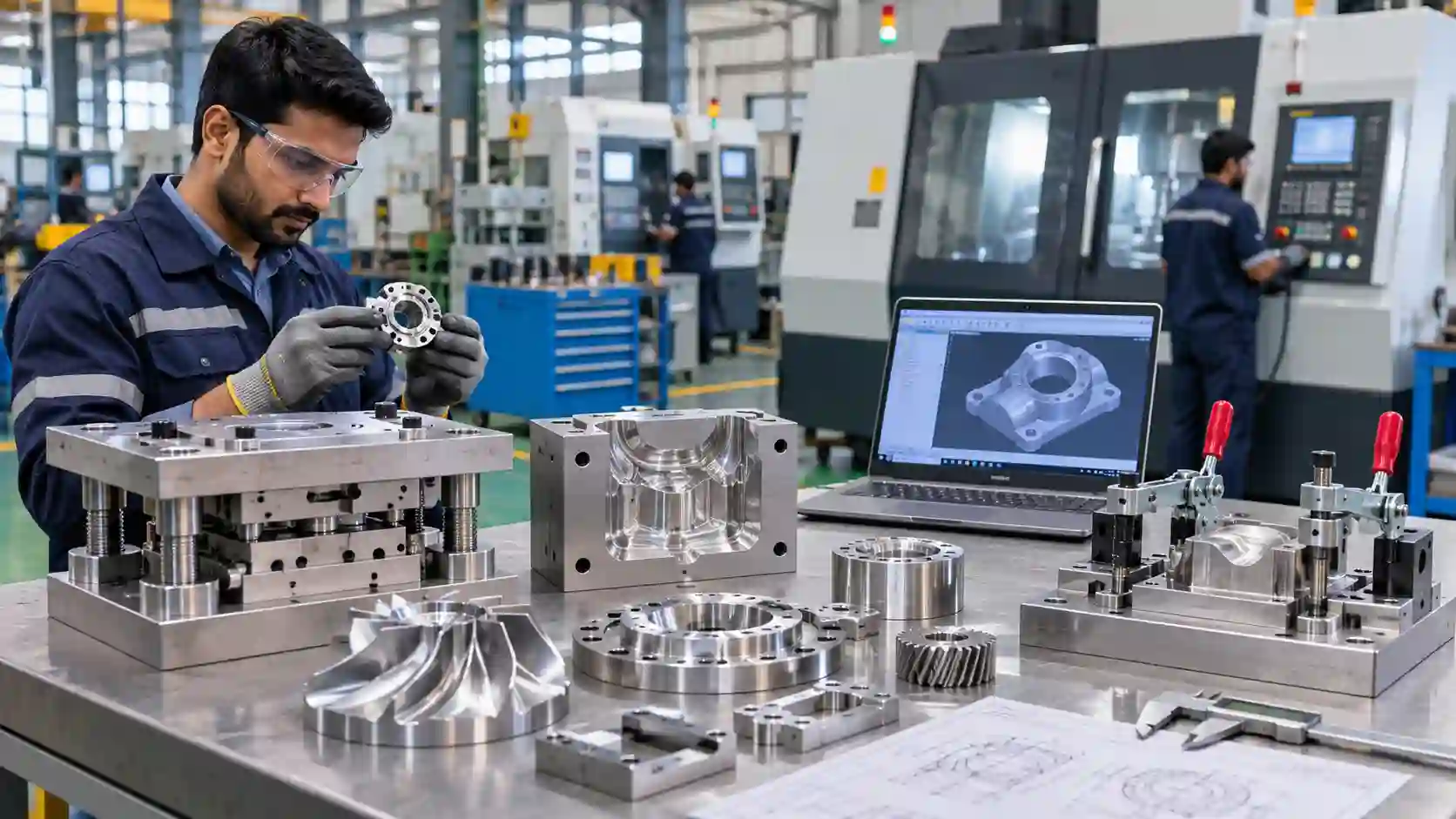
Various synchronized engineering and machining processes are involved in the production of Custom die casting tools. All these phases will add to accuracy, durability and functionality of the tool completed..
Typical tooling development processes include:
- CAD design and engineering: Geometry development of tools and analysis of manufacturing requirements of the component.
- CAM programming: Writing machining strategies of complex tool features.
- CNC machining: Making surface, cavities, pockets and precision tool elements.
- EDM machining: Making complex shapes and areas that need specialised machining access.
- VMC machining: Machining complex surfaces and geometries.
- Grinding and finishing: Refining where necessary: dimensional accuracy and surface quality.
- Assemblies of tools: The cavities, cores, inserts, cooling and ejection systems are assembled.
The collaboration with competent Pressure die casting tool manufacturers assists in organizing these processes through design to the manufacturing and inspection.
Quality Checks for Automotive Pressure Die Casting Tools
Cast components are directly affected by the quality of tooling. Checking at various production phases can be used to detect dimensional variations and assembly problems prior to production tests.
Key quality checks are:
- Cavity, cores, insert and tool component dimensional inspection.
- Die alignment and parting-line check
- Checking cooling channels and venting systems
- Checks of surface finish and cavity conditions
- Movement and alignment of ejector mechanism
- Sample component testing and trial casting
- Comparison of component sizes with engineering drawings.
The formal pressure die casting tool inspection process assists in detecting any potential problems at an early stage, minimizes needless tool changes and enhances preparation to production.
Factors Affecting Custom Die Casting Tool Requirements
Each automotive part requires different tooling. The design of the tool and the method of manufacturing are based on a number of technical and commercial aspects.
| Factor | How it affects tooling |
|---|---|
| Alloy selection | Affects temperature, flow behavior, wear and tool material requirements. |
| Component geometry | Identifies the complexity of cavities, cores, slides and parting lines. |
| Tolerance requirements | Impacts machining, inspection and design allowances. |
| Cavity configuration | Affects tooling layout, machine requirements and output. |
| Production volume | Helps identify tool life, maintenance and investment in tools. |
| Casting machine specifications | Decides die size, mounting, shot capacity and operating needs. |
| Surface finish | Shapes cavity finishing and part needs. |
By considering these factors early, manufacturers are able to choose the right custom die casting tools and prevent needless design modifications in the development process.
Why Choose Integrated Solutions for Automotive Die Casting Tools?
The choice of the appropriate tooling partner has the potential to impact the product quality, timelines of the project, cost of production and maintenance needs. Integrated Solutions specializes in engineering and production support as a way of assisting companies in solving their precision tooling requirements.
Engineering-Focused Approach
The tooling needs are discussed based on the component geometry, technical drawings, choice of material and production goals.
Precision Machining Support
The manufacturing of tooling components with complicated geometry and dimension specifications is supported by CNC machining, EDM, VMC operations and grinding.
Custom Tooling Solutions
The tooling can be designed to meet the requirements of certain components instead of a standard design to be used on all applications.
Production and Tool Room knowledge
The tool room services facilitate the production of dies, modification and repair of tools and manufacturing engineering-related requirements.
Project-Based Coordination
Specifications, tolerances, materials and production requirements can be discussed at the outset to bring tooling development in line with the goals of the customer.
Integrated Solutions offers precision tooling and engineering solutions, such as die-casting dies, CNC machining, EDM, grinding, CAD/CAM and custom tooling development. Companies that require an aluminum and zinc pressure die casting tool company can negotiate their needs such as component drawings, choice of alloy, tolerances, and volume of production.
Conclusion
Good automotive parts demand tooling that provides accuracy, repeatability and dependability in manufacturing. The complex geometries, controlled metal flow, and repeatability results are assisted by a well-designed aluminum zinc pressure die cast tool.
Integrated Solutions provides engineering and custom tooling solutions to the automotive manufacturing needs. You can call the team about your die casting tool needs, send your drawings and ask them to send you a tailored quotation.
| Contact Integrated Solutions today to request a query of custom pressure die casting tools and automotive tooling requirements. Give your drawings and specifications to begin your tooling project discussion. |