
Table of Contents
- Jigs and Fixtures: Same Family, Different Jobs
- How Jigs and Fixtures Improve Manufacturing Accuracy
- Applications of Jigs and Fixtures Across Industries
- What Goes Into Accurate Jig Design
- Where Panel Checkers and Gauges Step In
- Is Custom Tooling Worth the Investment?
- Custom Jig and Fixture Manufacturing at Integrated Solutions
- Why Choose Integrated Solutions for Tooling
- Conclusion
Two components leave the same machine. They both look great on paper. On the line, one fits, the other doesn't. This gap often begins in setup, with small variations in the positioning of a feature that snowball to a misfit, dimensional drift and production never-repeats.
Anything that is part-marked, held by feel and re-referenced between operations is prone to error. A properly engineered jig and fixture takes this guesswork out, by determining the position of the part and the part's holding. This blog explains exactly how that works, and how it can save manufacturing accuracy.
Jigs and Fixtures: Same Family, Different Jobs
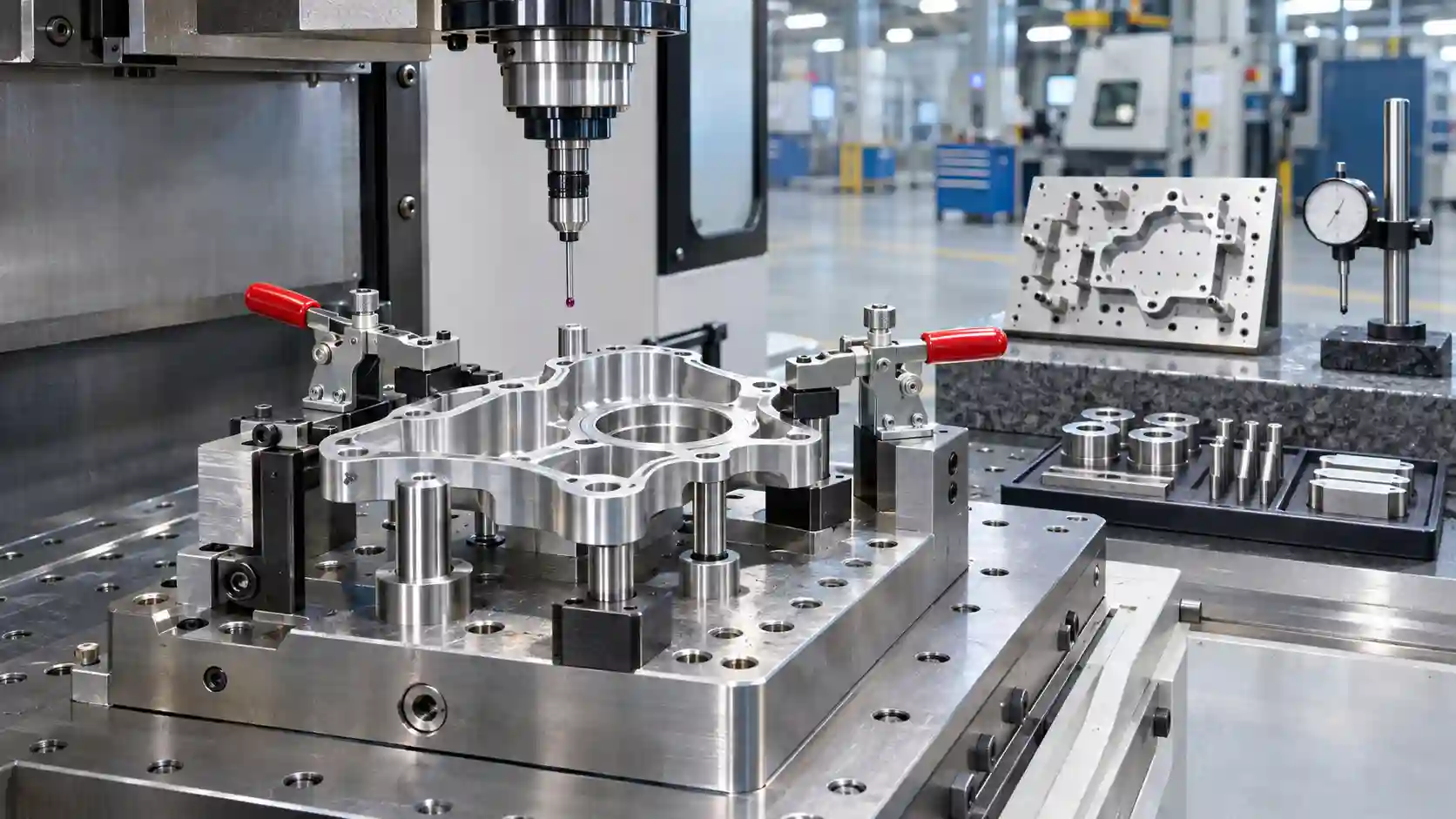
Jigs and fixtures is the device used to locate and hold a piece during a manufacturing operation. The main difference between the Industrial Jigs and Fixtures is the handling of the cutting tool.
| Feature | Jig | Fixture |
|---|---|---|
| Guides the Tool | Yes, through bushings | No, the machine sets the path |
| Typical Operations | Drilling, reaming, tapping | Milling, grinding, welding, inspection |
| Mounting | Often portable | Usually bolted to the machine table |
| Example | Drill jig for a bracket | Milling fixture for a housing |
Role of Jigs in Manufacturing Operations
The industrial jigs hold the workpiece and direct the tool. The drill jig uses hardened bushings so every hole hits what the drawing says the operator doesn't mark or measure.
Role of Fixtures in Production Processes
Manufacturing fixtures are used to hold and support the work piece during machining and assembly operations. They withstand the cutting forces, reduce vibration and prevent the part from moving. Machine: the toolpath. Fixture: the work position.
Where Accuracy Quietly Slips Away
Truth seldom bursts out in a single stroke. It is lost gradually along the way, and three factors contribute to the greater part of this diminution.
- Measures can be marked and logged by several operators.
- Repeated clamping (each re-fixment pushes the part marginally)
- Every shift in datum across six operations, stacking tolerance errors
Let us take a bracket with four holes on a fixed pitch. By hand the hole locations are off by a few tenths of a millimetre from part to part. Using a drill jig that number shrinks to a few hundredths of a millimetre. Same machine, same person, tighter tolerance.
How Jigs and Fixtures Improve Manufacturing Accuracy
A jig and fixture set affords four improvements: accuracy of locating, firmness of clamping, repeatability of setting, and greater insensitivity to the operator. In combination, they make precision manufacturing a product result rather than a personal skill.
Consistent Component Positioning
Datum points are used to locate a position. The foundation of the 3-2-1 rule is three points on the first face, two on a second face and one on a third. That's the elimination of all six degrees of freedom. Use more locators and the part distorts. Use less and it shifts. Precision Jigs and Fixtures obey the same rule to keep components consistent.
Reduced Setup Errors and Production Variation
Consistent workholding replaces trial-and-error setups. Operators load, clamp and start. Fewer adjustments mean fewer machining errors and tighter variation across shifts. Industrial jigs and fixtures also shorten setup time, which frees machine hours for actual cutting.
Applications of Jigs and Fixtures Across Industries
Industrial jigs and fixtures come into play wherever parts are to be produced to a drawing batch after batch. Every industry makes a different request, and a good Jig and Fixture Manufacturer builds to that request.
- Automotive: Welding fixtures for the chassis brackets, drill jigs to mount the plates.
- CNC machining: Milling fixtures for pump bodies and flanges.
- Manufacture of sheet metal: Bending and pressing tools for both enclosure and panels.
- Industrial assembly: Gearbox cover and motor frame aligners.
What Goes Into Accurate Jig Design
Accurate by design. Jig and fixture design should start with a component drawing and finish with a tool to which the operator can easily adapt. The designing process is influenced by six variables: material, clamping force, component shape, locating points, tolerance stacks and accessibility.
Material Selection and Tool Durability
When wear occurs, it occurs most on locators and bushings. Hardening tool steel will offer wear resistance, although mild steel is appropriate on the body as rigidity is more critical than hardness. Wear-resistant locators ensure long production runs of custom jigs and fixtures.
Clamping and Positioning Requirements
Hold securely - but do not bend the part. Thin sheet metal and castings have their edge distorted or gaping when uneven force is used. Place clamps over supports and precision manufacturing remains. Allow room for loading and the operator's hand.
Where Panel Checkers and Gauges Step In
Make the part right. Inspection tooling does the trick. Panel checker supports a sheetmetal panel in its proper position and inspects contour, trim lines, flange profile and hole position with go/no-go pins and gauges. Misalignments are visible in a flash - no waiting for a CMM.
The receiving gauge is used in this final step. The parts are loaded in it, and a fit determines acceptance. The rejects drop out into the dock, before the rejects arrive on the line. Integrated Solutions fabricates both, using the same drawings the production tooling is based on.
Is Custom Tooling Worth the Investment?
Not all parts warrant tooling. Consider batch size, how tight tolerances are, and the expense of rejection versus the cost of the tooling when considering.
- Batch size: Repeat orders repay tooling quickly.
- Tolerance: Tight limits are not easy to maintain by hand.
- Rejection cost: Scrap and rework often surpass the cost of tooling.
3D printed fixtures can be used as a step between prototypes and hard tooling.
Custom Jig and Fixture Manufacturing at Integrated Solutions
Tools are built from customer drawing /(Computer-Aided Design) CAD files at Integrated Solutions. We do rebuilds of conventional items for obsolete parts with no drawing by reverse engineering of data rebuild from a 3d scan. Our tool room runs cnc, EDM and grinding so we have a jig and fixture manufacturer and inspection tooling in one house which means we can have custom jigs and fixtures fit the final gauge.
To share an opening quote:
- Part drawing or CAD file
- Tolerances and material
- Batch volume
- Machine type or inspection method
Explore the full jig, fixture, panel checker and receiving gauge range.
Why Choose Integrated Solutions for Tooling
Tooling only benefits when on time and made to print. Buyers working with us can expect.
- Timely delivery to keep your production plan on schedule
- Top-notch quality products, inspected before dispatch
- Large quantities treated with the same care as a one-piece order
- Customisation offered on each component, process and tolerance.
Conclusion
Production accuracy is control not correction. Jig and fixture control location, clamping and repeatability so manufacturing accuracy is protected from the first part to the thousandth. Panel checkers and receiving gauges then verify the result. Select tooling that is designed around your component, tolerance and volume and you will see the savings as less rework.
|
Need Custom Jigs and Fixtures? Share your drawings with Integrated Solutions for precision tooling solutions. Contact Us Now! |