
Table of Contents
- Why Do Industrial Businesses Need Custom Proto Parts?
- Key Benefits of Choosing Proto Part Manufacturers in India
- Materials Used in Custom Proto Part Manufacturing
- Industrial Applications of Proto Parts
- What Information Is Needed for Custom Proto Part Orders?
- Why Choose Integrated Solutions for Custom Proto Parts?
- Conclusion
A drawing may be flawless on a monitor. The first piece of cast metal lands and the hole is 2mm out. Most engineers have been through this. That's why proto parts are critical. They convert a design from 2D to a 3D object that is tangible, measurable and tested before mass production. For many industrial customers, working with proto part manufacturers in India is an effective solution for custom requirements.
This blog discusses how that is achieved, which processes are used and what you need to prepare before requesting a quote.
Why Do Industrial Businesses Need Custom Proto Parts?
A digital model can't do all the work. The physical samples reveal what the simulations overlook, which is why Custom Proto Parts are a common part of the product process.
Here is what they assist you to check:
- Are critical dimensions and tolerances in accordance with the drawing.
- How does it react to pressure, motion or temperature?
- How does it link to mating features in an assembly?
Where the design is able to be improved, for example, thin walls/ difficult access features. A learned lesson here is that you can rework it quickly. The same flaw after tooling can be difficult to rework. Reliable industrial proto parts protect the project from that situation.
Key Benefits of Choosing Proto Part Manufacturers in India
India has a sizable engineering workshop industry and fabrication capacity. When you work with Proto Part Manufacturers In India, you have the ability to offer buyers ranges of specifications and direct engineering discussion, space for revision of the first samples, and planning for production, because the same supplier sees the project through from first sample on. Precise timing and pricing are project-specific.
Custom Manufacturing Based on Project Requirements
All projects begin with their own inputs. A quality manufacturer will use your CAD drawing, dimensions, grades and design brief – not wrestle with a standard catalogue product – when making your part. This is especially important if your part has unique geometry, demanding tolerances or a specific surface finish. Using a single drawing set can also simplify the process by providing a straightforward repeatable order of custom proto parts – fewer gaps between the buyer and shop floor.
Design Validation Before Full-Scale Production
When you receive your prototype, take it for a test drive. Use it to verify fit, to do functional tests, and to identify modifications. One of the great advantages of prototype component manufacturing is how quickly design issues, like part interference, limited access for assembly or a fragile section, reveal themselves. Update your design, then order another revised sample before moving into production.
Manufacturing Processes Used for Custom Proto Parts
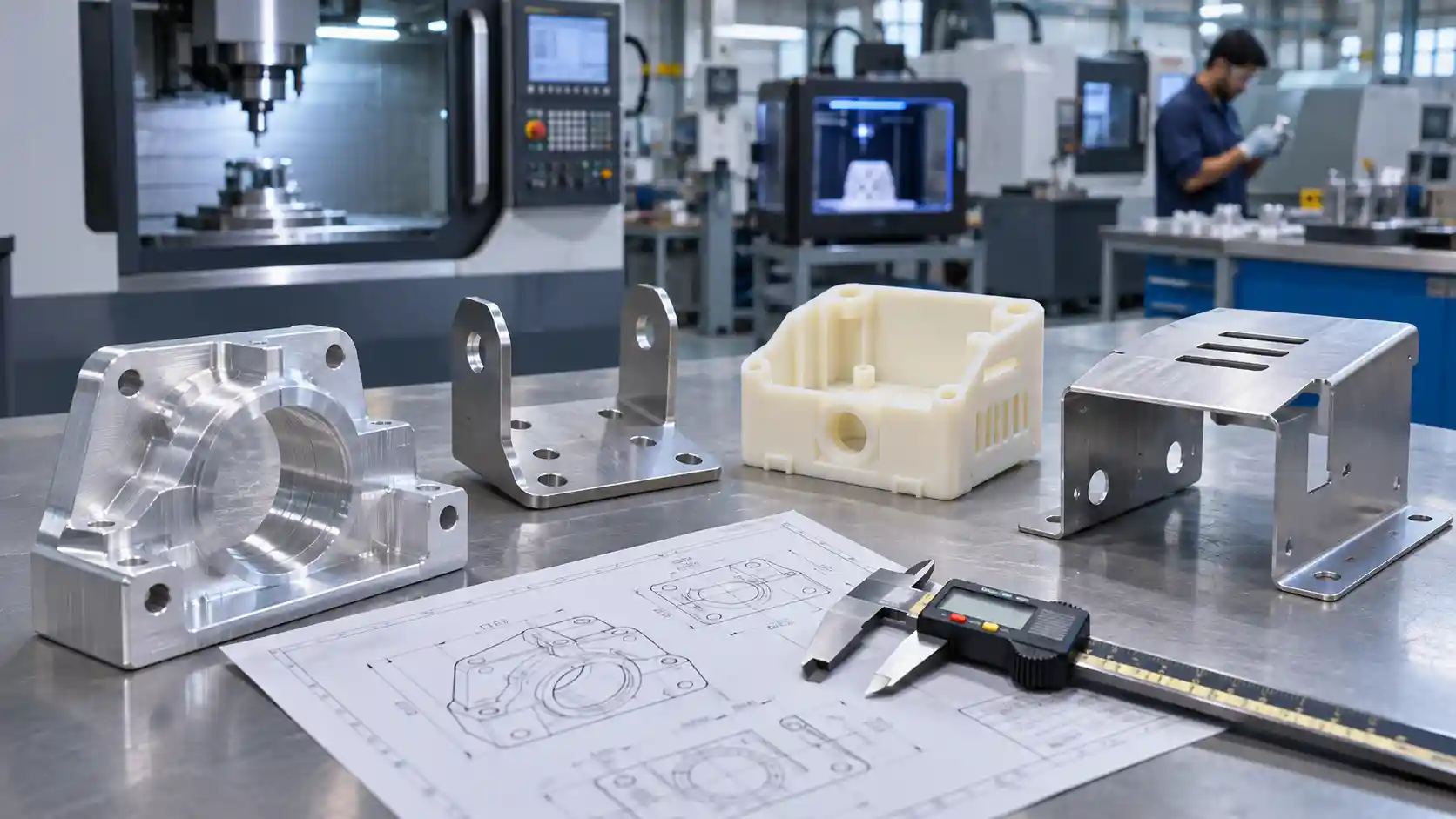
There is no perfect method for everything. The best approach varies based on the geometry, material, number and goal of the prototype. Typical paths for proto part manufacturing are CNC machining, 3D printing, sheetmetal fabrication and rapid tooling.
CNC Machining and 3D Printing
CNC machining cuts away from a solid block to achieve desired shapes. It's an ideal choice for components that require tight tolerances, dust-free finishes and industrial-quality materials. CNC prototype parts are frequently selected when the sample needs to mimic the end-product.
3D printing is a layer-by-layer process. It is particularly effective for intricate geometries, internal passages, and quick form-and-fit assessments. The fact that certain shapes are difficult to machine can make additive manufacturing a valid option.
Sheet Metal Fabrication and Rapid Tooling
Brackets, enclosures, panels and frames are often manufactured by cutting, bending and welding. Sheet metal prototype parts are ideal for testing bend locations, punch hole locations, and fit and assembly before dedicated tooling is made.
If a part requires a mold or die, rapid tooling can be used to make a simple, short-run tool for a sample batch. This allows you to test the part design in your actual process prior to committing to full production tooling.
Materials Used in Custom Proto Part Manufacturing
The material you select makes a big impact on the end performance of your prototype. Even a part that passes a fit check with the wrong grade of material can fail a functional test.
Here is a list of the usual choices and considerations for each:
| Material | Best Suited For | Key Consideration |
|---|---|---|
| Mild Steel | General engineering parts and fixtures | Needs coating for corrosion protection |
| Stainless Steel | Parts exposed to moisture or chemicals | Harder to machine, so check the method |
| Aluminium | Lightweight parts that still need rigidity | Lower strength than steel |
| Brass and Copper Alloys | Conductive or corrosion-resistant parts | Right grade depends on the application |
| Engineering Plastics | Lightweight, insulating or wear-resistant parts | Heat and load limits vary by grade |
Consider load, operating temperatures, surface finish and the final production material. Testing a proto part with a closely matched final production material will give much more relevant results. Your prototype materials should be representative of the end-use, not just the easiest to machine.
Industrial Applications of Proto Parts
Prototypes are used when a design needs proof before it scales: Commonly in the following areas:
- Parts for automobiles, used in the mounting, brackets and housing of-automotive components.
- Industrial machinery, components, fixtures and guards.
- Assemblies designed for fit and motion testing.
- Products project that are transitioned from idea to pilot batches.
In all instances, Industrial Proto Parts ensure that decision-makers act based on real samples, rather than guesses. With the ability to create custom prototype parts, designers and purchasing managers can also bring a common benchmark into the process.
What Information Is Needed for Custom Proto Part Orders?
A clear enquiry deserves a clear quotation. Be prepared before you make enquiry to proto part manufacturer as follows:-
- Drawings in PDF or similar format
- CAD models like STEP or IGES files
- Material grade and any standards to follow
- Tolerance ranges on vital dimensions
- Quantity, including any follow-up batches
- Surface finish or coating requirements
- Delivery requirements and target dates
If some inputs are as yet unresolved, declare so. A strong team will propose options for your custom proto parts based on what you provide.
Why Choose Integrated Solutions for Custom Proto Parts?
Integrated Solutions assist customers that require parts to be made to their own specifications. Drawing based manufacturing and modification assistance can be provided on all of the above listed manufacturing processes, to enable buyers with existing drawings to simply submit them and convert to an actual sample. Most projects are started with an existing drawing and a rough set of specifications, where the team picks up from.
If you are comparing proto part manufacturers in India, it is worth reviewing Integrated Solutions to see the range of work it handles. Integrated Solutions can then discuss your drawing, material and quantity before you place an order.
Conclusion
Custom proto parts lessen risk. They let you prove dimensions, evaluate function and troubleshoot design issues before you commit to production. The right prototype part manufacturers in India can provide you with a variety of processes, material options and engineering input for custom orders. The more information you gather up front the more successful your proto part order will be. Get your drawings, material, tolerances and volume together and send Integrated Solutions a quote request to advance your proto part project.
|
Looking for reliable custom proto parts for your industrial project? Share your CAD drawings, material specifications, tolerances, and required quantity with Integrated Solutions for tailored manufacturing solutions. Contact Us Now to discuss your requirements and request a quote. |