
Table of Contents
- Why Choosing the Right Cast Iron Manufacturer Matters
- Evaluate Manufacturing Capabilities and Infrastructure
- Verify Material Grades and Technical Specifications
- Examine Quality Control and Testing Procedures
- Quality Checks at a Glance
- Assess Custom Manufacturing Capabilities
- Check Experience Across Industrial Applications
- Evaluate Production Capacity and Supply Reliability
- Compare Manufacturers Beyond the Lowest Price
- Common Red Flags to Watch Out For
- Questions to Ask Before Selecting a Cast Iron Manufacturer
- Conclusion: Choose a Manufacturer for Quality and Reliability
Buying cast iron parts for a factory floor isn't a one-time transaction, whatever the sales rep tells you. Quality that dips halfway through an order. Deadlines that slide. A vendor who sounded rock-solid on the phone and then... didn't deliver. Picking a real cast iron manufacturer means asking a harder question: will this supplier still be consistent on order fifty? Most buyers only find out the answer is no after a batch gets rejected, or a part cracks under load nobody expected. Integrated Solutions pushes buyers to ask that question early. Here's the actual checklist, not the polished version.
Why Choosing the Right Cast Iron Manufacturer Matters
Think about what rides on this one decision. Dimensional accuracy. Whether the part lasts five years or fifteen. Rejection rates that stay flat, or creep up quietly. Your timeline holding, or slipping. A dependable Cast Iron Manufacturer keeps all of that boring and predictable, which, honestly, is the whole point. Pick wrong and it shows up later as returns, unflagged delays, a batch that doesn't match the last one. Spend a week vetting now. It beats three months untangling a bad vendor mid-project.
1. Evaluate Manufacturing Capabilities and Infrastructure
Skip the sales pitch. Go look at the actual production floor. The gap between decent and genuinely strong cast iron manufacturers in India almost always comes down to what's sitting on that floor — foundries, machining setups, finishing lines built to flex across jobs. Ten minutes walking the facility tells you more than the entire brochure.
A few things worth checking while you're there:
- What casting methods do they run, and at what capacity
- Machining and finishing in-house, or handed off elsewhere?
- Small batch today, bulk order next month — can they do both?
- Equipment condition. Not what they say, what you see.
- Pattern-making in-house for new designs
Check Fabrication and Machining Capabilities
Raw castings aren't always the ask — a lot of buyers want a finished part they can bolt straight onto a machine. That's the fabrication side of things, worth a separate conversation before you commit to a cast iron fabrication vendor. Miss it, and you're coordinating two or three suppliers for one part.
Ask directly whether they handle:
- Precision machining and drilling
- Finishing, coating, whatever the surface needs
- Assembly work, even sub-assemblies
- Small dimensional changes without a big fuss
2. Verify Material Grades and Technical Specifications
Cast iron isn't one material — grades vary, and buyers who treat it as generic usually regret it. A Cast Iron Material Suppliers worth your time confirms grade, composition, tensile strength, hardness, before production starts, not after. Get the grade wrong and nothing looks off on paper — the part just fails later, once it's already installed and taking real load. At that point it's not a documentation problem. It's a shutdown.
So before you place the order, get confirmation on:
- Grade — grey iron, ductile iron, or something else entirely
- Composition certificates, in writing
- Tolerances that match your actual application
- Real operating conditions, not lab conditions
- Do test reports come standard, or do you have to chase them?
3. Examine Quality Control and Testing Procedures
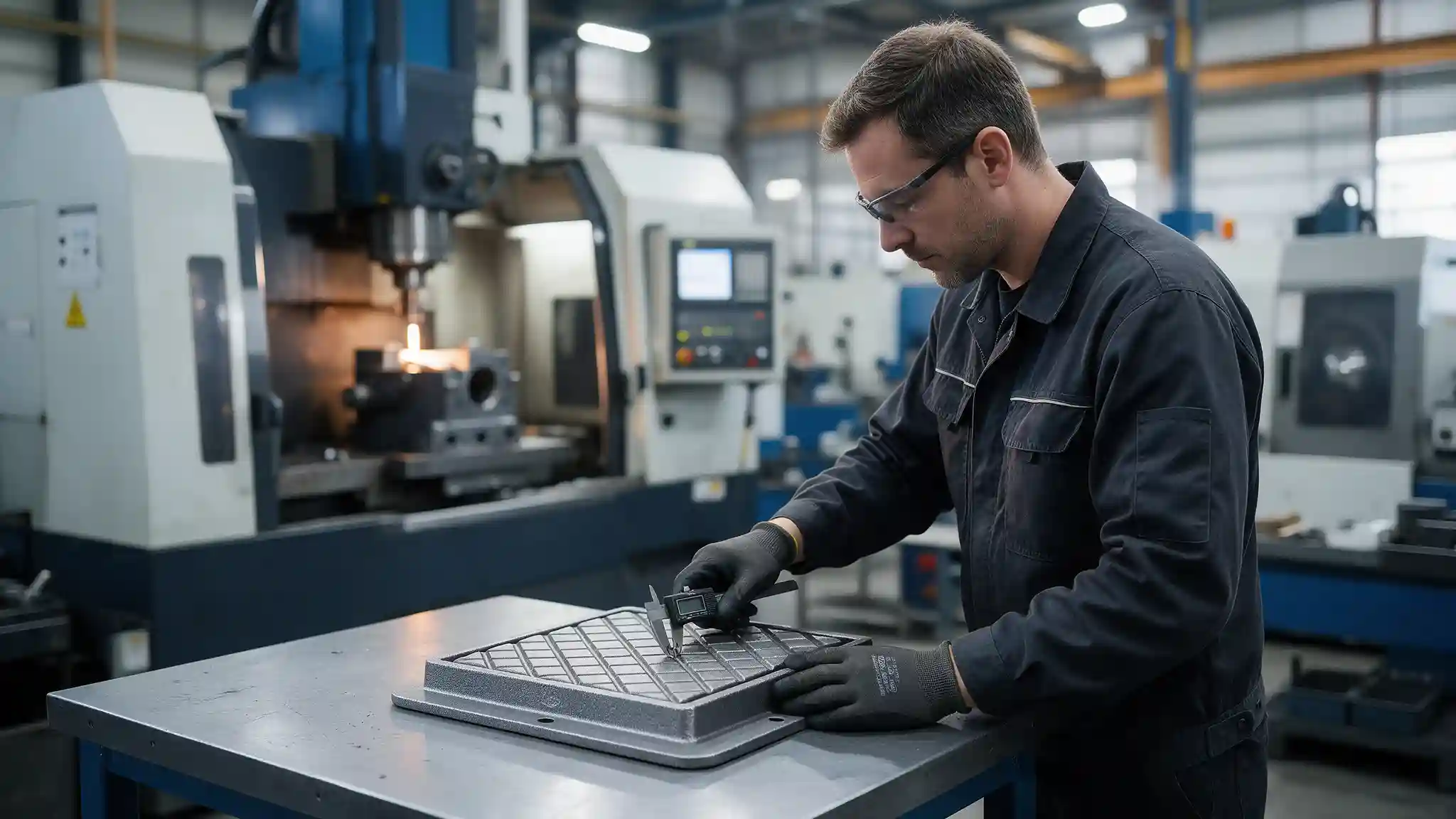
One good batch means nothing alone. What matters is batch fifty looking like batch one. Reliable cast iron manufacturers check dimensions, verify material, and screen for defects at more than one stage — and hand over paperwork without being asked twice. That's really the whole difference between a cast iron components suppliers you trust and one you're hoping works out. Skip the checks, and the failure shows up on your assembly line, where fixing it costs far more than catching it early would have.
Quality Checks at a Glance
Roughly, here's how the checks break down:
| Quality Check | What It Verifies |
|---|---|
| Dimensional Inspection | Matches drawings and tolerances, or it doesn't |
| Material Testing | Grade, hardness, tensile strength |
| Visual / Defect Check | Cracks, porosity, casting flaws |
| Documentation | Certificates, batch traceability, paper trail |
|
Trivia “Cast iron's older than most people think — over 2,500 years old, actually. Chinese foundries were casting pots and pipes with it centuries before it turned into the backbone of modern industry.” |
4. Assess Custom Manufacturing Capabilities
Sometimes a catalogue part just doesn't fit — not close, not even in the ballpark. A decent cast iron manufacturer works off your drawings, CAD file, or a physical sample, adjusting dimensions and finishes without doubling the lead time or demanding some absurd minimum order. This matters most when you're replacing something obsolete, or building a part that doesn't exist off the shelf.
A few things to look for here:
- Can they actually read a CAD file, or do they just say they can?
- Sample or prototype before you commit to the full run
- Real flexibility on tolerances and finishes
- Scaling from one sample to a hundred units, smoothly
- Open to revising a design after the first round of feedback
5. Check Experience Across Industrial Applications
A manufacturer that's only served one type of client tends to think in one direction. Vendors who've worked machinery, automotive, engineering and construction have usually seen more load scenarios and compliance headaches than someone selling generic Cast Iron Solutions to whoever walks in. If they've solved a version of your problem before, you're not their first attempt.
Worth looking for experience in:
- Heavy machinery, industrial equipment
- Automotive and precision engineering work
- Construction-grade cast iron products
- General components, across a mix of industries
|
Did You Know? “This one surprises people every time — cast iron parts can stay structurally sound for 50 years, sometimes longer, in demanding conditions. Wear resistance, corrosion resistance, compression strength — it's just built for the long haul.” |
6. Evaluate Production Capacity and Supply Reliability
Quality matters. But can they deliver at scale, order after order, without falling apart the moment demand spikes? Bulk capability, lead times that hold, inventory that's actually planned rather than improvised — that's what keeps a supply chain steady. A real cast iron supplier proves it across dozens of orders, not one flawless sample that never gets repeated.
Things worth checking here:
- Repeat orders without quality slipping
- Lead times that hold up in practice, not just on a quote sheet
- Packaging that actually survives transit
- Inventory planning built around your recurring orders
- Do they warn you before a delay, or after?
7. Compare Manufacturers Beyond the Lowest Price
The cheapest quote is rarely the cheapest option — it just moves the cost somewhere less visible: rework, delays, a support line that goes quiet once the invoice is paid. Smarter buyers judge Cast Iron Suppliers on consistency and rejection history, not the number at the bottom of a quote.
Look past price and compare instead:
- Rejection and rework rates, over time
- How fast their technical support actually responds
- Flexibility on custom or special orders
- Delivery record — on time, actually, not roughly
Common Red Flags to Watch Out For
It helps just as much to know what should make you stop and think twice. The same warning signs keep showing up across unreliable vendors — spot them early, and you skip a much more expensive correction later.
Pause if a manufacturer:
- Won't share test certificates or inspection reports
- Gets vague the second you ask about lead time or capacity
- Can't explain their own QC process in real detail
- Insists on a huge MOQ with zero room to negotiate
- Has never worked with your industry before
Questions to Ask Before Selecting a Cast Iron Manufacturer
A short list of questions, asked upfront, saves weeks of back-and-forth down the road — and gives you something to actually compare vendors against, instead of just going on how the call felt.
Ask, before you finalize anyone:
- Which material grades do you offer, and can you certify them?
- Can you hit our exact dimensional specs?
- What's the real MOQ, and the real lead time?
- Do you work from drawings for custom parts?
- What checks happen at each stage of production?
- Can I see documentation and batch traceability?
- What happens when a batch fails inspection?
Conclusion: Choose a Manufacturer for Quality and Reliability
It really comes down to three things when picking a cast iron manufacturer: capability you've actually verified, quality that repeats, and supply you can rely on. Not the lowest number on a quote. Buyers who take the time upfront — checking infrastructure, testing, delivery history — end up with fewer surprises and partnerships that actually hold. Treat the first order like a test, because it is one. How a vendor handles it tells you how they'll handle the hundredth. Integrated Solutions brings exactly that mix of technical know-how and reliability to industrial buyers across India — the kind of cast iron manufacturers in India standard that holds up, order after order, without excuses.