
Table of Contents
- Tool Types Behind Precision Stamping
- How Manufacturers Build Accuracy into Tools
- Design Factors That Decide Tool Performance
- From CAD Model to Stamping Trials
- Where Precision Stamping Tools Are Used
- Sheet Metal Tool Manufacturing at Integrated Solutions
- Conclusion
If a cookie cutter touches dough, a cookie is formed! Touch it again and you'll receive the same cookie. Imagine that cookie cutter, which is steel, cutting a thousand brackets an hour. If one cut is off by a hair, then all brackets following that one are off as well. This is the force of metal stamping. The buyers want uniformity in all parts. That is the responsibility of sheet metal tool manufacturers, as the part depends on the tool.
In this blog we will learn how tools are constructed, how they can be made accurate, and what to share with the tooling company to get a precision stamping tool.
Tool Types Behind Precision Stamping
All stamped components begin with a tool in a press. A tool used to cut or shape flat metal in one stroke is called a Sheet Metal Tool. The majority of the sheet metal stamping tools perform five tasks, which are blanking and piercing, cutting, bending and forming.
Progressive, Compound and Transfer Dies
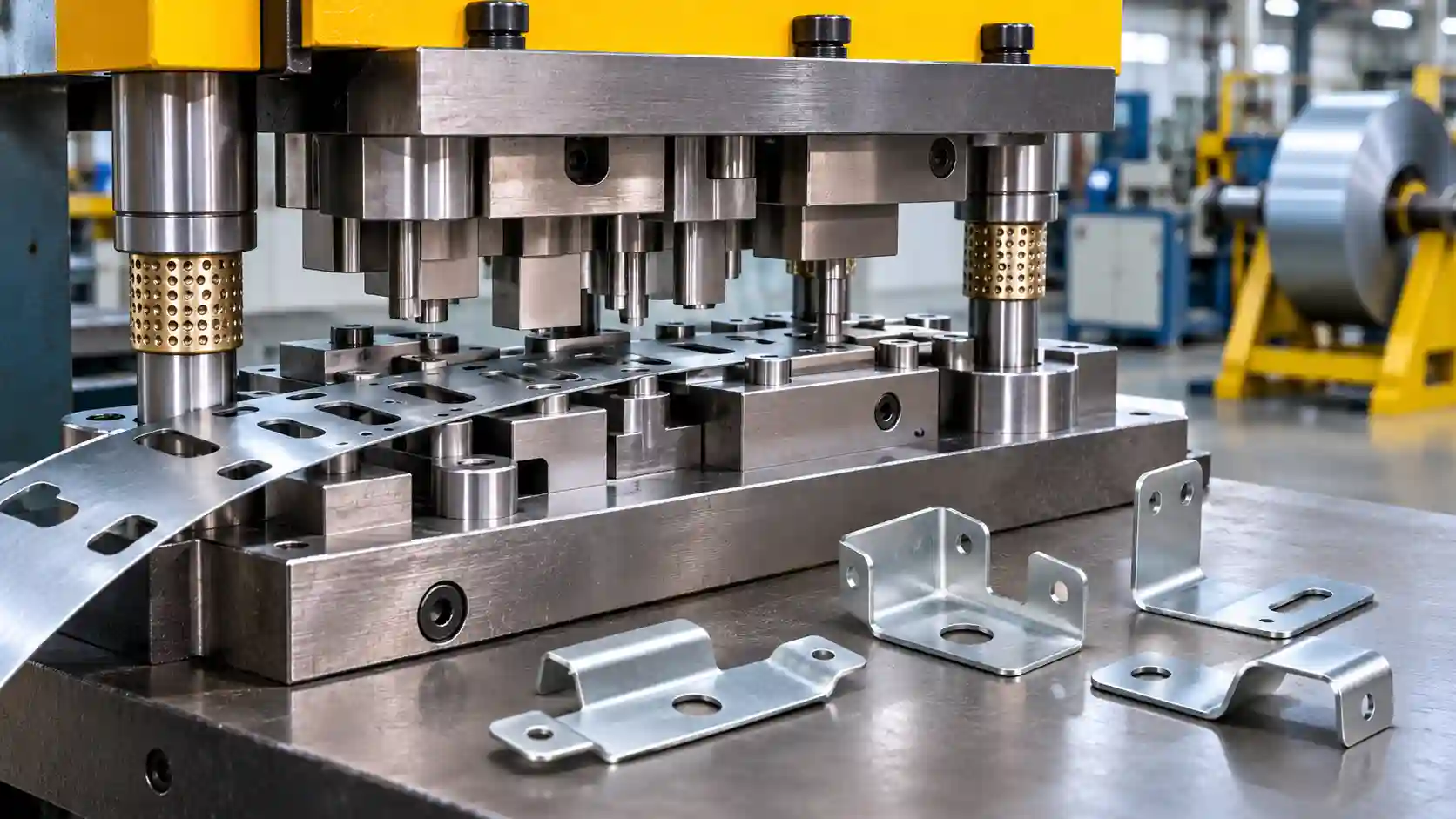
Progressive dies function as a "production line" within a single tool. A metal strip is moving from station to station. One station punches a hole, the next station bends an edge and the last station cuts the finished part free. They are used for parts that require to be produced in large quantities.
Compound dies make cutting in one motion. One example is a washer. The hole and outer circle are cut together – they don't shift position.
Whereas, transfer dies are used for larger and deeper parts. Each part is picked from one station and taken to the next station by fingers.
Blanking, Piercing and Forming Tools
Blanking dies are used to cut out the outline of a part from a flat sheet of material. Imagine cutting a paper star out of a sheet of paper using scissors. The star is yours to play! Those are holes that are punched in the middle, such as the holes in a bracket.
After that, there are Sheet Metal Forming Tools. They do not cut. They bend and shape the metal to form curves, flanges and ribs; a flat piece becomes useful. A lot of parts require all three jobs which is why tools are frequently grouped together. The proportions are up to you and your drawing.
How Manufacturers Build Accuracy into Tools
A good tool is not necessarily made from hard steel. It is steel that is manufactured according to a plan. It is at this stage that precision sheet metal stamping is made or broken, before the first part is stamped.
There are two most important factors to consider: Alignment and repeatability.
Punch and Die Alignment and Clearance
The punching moves to the down position. The die rests on the bottom. The clearance between them is very small and is often a small percentage of the thickness of the sheet, it is called clearance. If it's too tight, it wears down quickly. If it's too loose, you'll end up with burrs, which are rough edges that can cut your fingers and make it difficult to assemble.
That gap remains the same on all sides with alignment. If the punch is a little off, one side will be cut and the other torn. This is avoided by using good precision stamping tools, which are ground and fitted. Wear matters too. Checking the condition of the part is a task in accuracy; a dull punch will slowly change the part.
Positioning and Repeatability
It's easy to cut the well once. The actual test is cutting well, ten thousand times. That needs repeatability.
The metal is advanced the same amount with each stroke in strip feeding. Pilots, small pins in the tool, fit in holes, secure the strip in place before cutting. Systems with single blanks are found in the same position as the others.
A continuous press cycle is helpful too. The output is even and the lubrication is clean, hence part 5,000 is equal to part one.
Design Factors That Decide Tool Performance
In toolmaking, a good toolmaker will ask questions first, as the answers dictate the entire Sheet Metal Tool Design. These are the items they inspect:
|
What the tool maker checks |
Why it matters |
|
Sheet thickness |
Thicker metal needs more force and a wider gap. |
|
Metal type |
Stainless springs back more than mild steel. |
|
Tool steel |
Harder grades resist wear longer but cost more. |
|
Press compatibility |
The tool must fit the press bed, shut height and tonnage. |
|
Die set rigidity |
A stiff die set does not flex under load. |
|
Maintenance needs |
Easy-to-swap inserts make upkeep simpler. |
All selections have an impact on the others. A weak die set that is given a good hammering is still weak and will flex and drift out of line. No good tool will run correctly if it's in the wrong press. All of that is balanced by well planned sheet metal stamping dies and that's what keeps parts in tolerance.
From CAD Model to Stamping Trials
Well-made tools begin on a screen! Engineers create the tool in a CAD program, and the program generates the machine instructions in a CAM program. The steel is then taken to CNC and VMC machines for shaping, and sharp corners and hard to reach profiles are created via EDM. The skilled fitters hand assemble the tool. They inspect fit, adjust clearance and polish as necessary.
Then comes the part where many buyers forget “proof”. Tool inspection involves comparing the size of each tool part to the drawing. Then the tool is put under pressure in a trial-run. Some of the samples are pressed and measured. If it's wrong the tool is fixed and retested. Samples must be passed before production can commence.
This is why it is advisable for buyers to ask one simple question from the Sheet Metal Tool Manufacturers In India – Do you try the tool before you ship it?
Where Precision Stamping Tools Are Used
Probably you've handled a stamped part today. Lots of them are found in tools like these and they are found in a lot of places than you'd expect.
- Automotive brackets that hold wires, sensors and panels.
- Electrical components like terminals, clips and contact plates.
- Industrial enclosures and industrial control boxes.
- Parts of a washing machine and fan.
It seems like these parts are straightforward, but they need to be fitted all the time. That's possible, batch-by-batch, with reliable industrial sheet metal tools.
Sheet Metal Tool Manufacturing at Integrated Solutions
At Integrated Solutions, we produce sheet metal tooling according to your drawing. The starting point of it all is your part drawing. Send it with the material, thickness, tolerances and quantity required and the tool is designed accordingly.
You don't have to know how to use the tools. A clear drawing will suffice to begin the conversation. Have one ready? Call Integrated Solutions and we're happy to talk. Read the sheet metal tools page for more information.
Conclusion
A stamped component is just as good as the tool which produced it. Part number one and part number one hundred thousand are the same by keeping them aligned, keeping clearance, positioning, and running them over a trial before. If you're looking for sheet metal tool manufacturers, ask them about the process of their inspection, their testing processes, and their use of your drawing. Their responses will demonstrate the look of your production.
Submit your drawing to Integrated Solutions today and let's talk about your custom sheet metal tooling needs.